
The Asam Sahitya Sabha posthumously conferred the prestigious ‘Sangeet Sudhakar’ title on legendary Assamese musician Zubeen Garg. The literary body conferred this posthumous honour for his extraordinary contribution to music, literature and the cultural heritage of Assam.
For UPSC, APSC, and other State PCS aspirants, this topic is important under Indian Culture, Assam Current Affairs, Assam Art and Culture, Cultural Institutions, Regional Identity, and Literary-Cultural Heritage. Aspirants preparing through UPSC coaching in the Northeast should study such topics carefully, as questions related to regional culture, important institutions, and the cultural heritage of Northeast India are frequently asked in both the Preliminary and Main examinations.
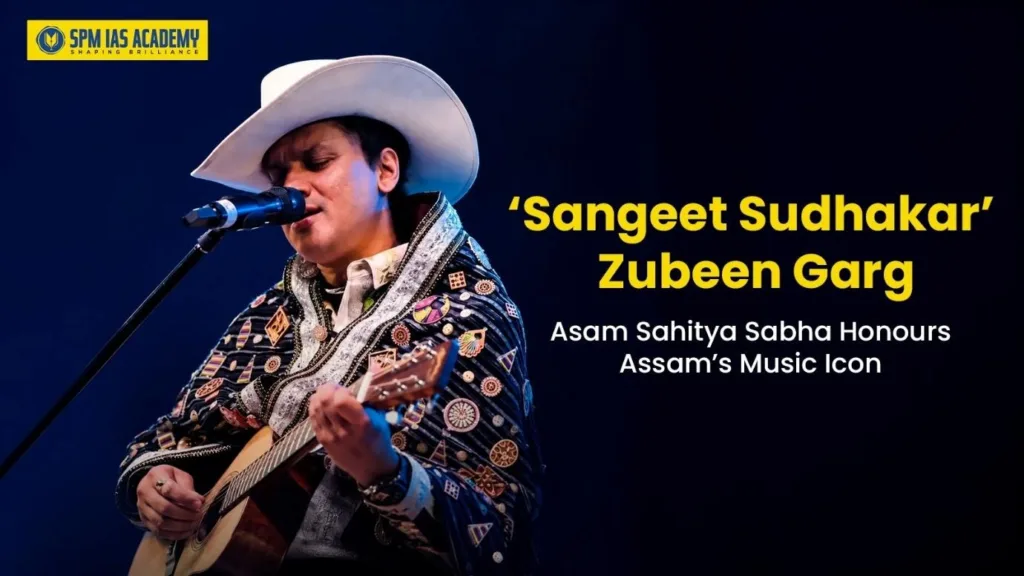
What is the ‘Sangeet Sudhakar’ Title for Zubeen Garg, the heartthrob of Assam?
Asam Sahitya Sabha’s ‘Sangeet Sudhakar’ title recognises exceptional contribution to music and cultural life. This title honours Zubeen Garg’s role in popularising Assamese music and strengthening Assam’s artistic identity.
The honour was formally conferred on 30 July 2026 at Sangeetacharya Lakshmiram Barua Sadan in Guwahati, with Asam Sahitya Sabha President Dr. Basanta Kumar Goswami presenting the title. Aspirants studying at an IAS coaching institute Assam should note this development, as awards, cultural personalities, and important literary institutions of Assam are relevant for current affairs as well as Art and Culture sections of competitive examinations.
Therefore, ‘Sangeet Sudhakar’ Zubeen Garg represents both institutional recognition and emotional tribute.
Who was Zubeen Garg?
Fondly called as the Heartthrob of Assam, Zubeen Garg was one of Assam’s most influential cultural icons. Born on 18 November 1972, he began his musical journey at an early age. He rose to fame with his debut album Anamika in the early 1990s. Over a career of more than three decades, he worked as a singer, composer, lyricist, actor, filmmaker and music director. He also recorded more than forty thousand songs across multiple Indian languages.
Why was he called the Heartthrob of Assam?
People widely called him the “Heartthrob of Assam” because his music connected generations, communities and emotions. Moreover, his songs reached beyond Assam and introduced Assamese musical expression to wider Indian audiences.
To know more, Read this Article on Zubeen Garg!
‘Sangeet Sudhakar’ Zubeen Garg and Assam’s Cultural Identity
Asam Sahitya Sabha’s decision to confer the title of ‘Sangeet Sudhakar’ on Zubeen Garg is of great cultural significance. Assam’s rich cultural history has long regarded music as a powerful medium of identity, emotion, and social expression. From Srimanta Sankardev and Madhavdev to Jyoti Prasad Agarwala, Bishnu Prasad Rabha, and Bhupen Hazarika, the state has produced legendary artists who shaped public consciousness through their artistic contributions. Aspirants preparing at an APSC training centre should understand the role of these cultural icons, as Assam’s literary and musical heritage is an important component of the Art and Culture syllabus as well as current affairs.
Zubeen Garg carried this tradition into the modern era. His music expressed love, grief, protest, youth aspiration, regional pride and social belonging. As a result, his work became part of Assam’s collective memory.
Zubeen Sangeet: A New Identity for His Songs
The Asam Sahitya Sabha also announced that all songs written and composed by Zubeen Garg would be collectively referred to as “Zubeen Sangeet.” This move gives a distinct cultural identity to his works.
In addition, the Sabha planned to publish an analytical book on Zubeen Garg’s music. The publication will include a compilation of his songs along with a detailed study of their themes, musical style, and cultural significance. The Sabha also announced plans to translate his songs into languages such as Tamil and Telugu, enabling a wider audience across India to appreciate Assam’s rich musical heritage. Aspirants engaged in APSC exam preparation should take note of such developments, as they are relevant to Assam Art and Culture, regional identity, and current affairs sections of competitive examinations.
Thus, ‘Sangeet Sudhakar’ Zubeen Garg is not only an honour. It is also part of a larger cultural preservation project.
Asam Sahitya Sabha’s Initiatives to Preserve Zubeen Garg’s Legacy
- The Asam Sahitya Sabha decided to organise a national-level seminar on the life and works of Zubeen Garg. Scholars from across the Northeast will present research papers, and the proceedings will be compiled into a book.
- Moreover, the Sabha also decided to translate selected songs of Zubeen Garg into English, Hindi and Bengali to introduce his works to audiences beyond Assam.
These initiatives show that cultural memory needs documentation, translation and academic engagement. Therefore, they can help future generations understand Zubeen Garg not only as a popular artist but also as a subject of cultural study.
Conclusion
Asam Sahitya Sabha’s ‘Sangeet Sudhakar’ title on Zubeen Garg is a major cultural recognition of an artist who shaped Assam’s emotional and musical landscape. Through this honour, the Asam Sahitya Sabha has acknowledged his extraordinary contribution to music, literature and Assamese cultural identity. Moreover, initiatives like Zubeen Sangeet, translations, seminars and analytical publications will help to preserve his legacy for future generations.
Read More:
Source:
Frequently Asked Questions
1. Why did the Asam Sahitya Sabha honour Zubeen Garg with the ‘Sangeet Sudhakar’ title?
The Asam Sahitya Sabha posthumously honoured Sangeet Sudhakar title on Zubeen Garg for his outstanding contribution to Assamese music, literature and cultural heritage. He played a major role in popularising Assamese music and connecting it with younger generations. Moreover, his work strengthened Assam’s cultural identity and introduced Assamese musical expression to audiences beyond the state.
2. What is ‘Zubeen Sangeet’ and why is it important?
The Asam Sahitya Sabha announced that songs written and composed by Sangeet Sudhakar Zubeen Garg would collectively be known as “Zubeen Sangeet.” This initiative gives his musical works a distinct cultural identity. Furthermore, the Sabha plans to document, study and translate his songs so that future generations and wider audiences can understand his contribution to Assamese culture.

Behind every article at SPM IAS Academy is a team of skilled content writers and subject experts committed to making preparation easier for aspirants. From answering common doubts to breaking down complex issues and current affairs, we create content that is accurate, easy to understand, and directly useful for UPSC, APSC, and other competitive exams.