

India is a constitutional federal republic comprising 28 States and 8 Union Territories (UTs). Each state has its own elected legislature and government, while Union Territories are governed directly by the Central Government, except Delhi and Puducherry which have partial statehood with elected legislatures. Understanding the political and administrative geography of India is a foundational requirement for any civil services aspirant, whether for UPSC (Union Public Service Commission) or APSC (Assam Public Service Commission) examinations.
The administrative structure of India has evolved significantly since its independence in 1947. The States Reorganisation Act of 1956 restructured states largely on linguistic lines. Subsequent decades saw the creation of new states — Nagaland (1963), Haryana (1966), Himachal Pradesh (1971), and more recently, Chhattisgarh, Jharkhand, and Uttarakhand (all in 2000), and Telangana (2014). The most recent significant reorganisation was the bifurcation of the erstwhile state of Jammu & Kashmir into two Union Territories — Jammu & Kashmir and Ladakh — on October 31, 2019, under the Jammu and Kashmir Reorganisation Act, 2019.
For APSC aspirants, the Northeast region deserves special attention, given the unique administrative, cultural, and constitutional position of northeastern states. Assam, with its capital Dispur (within Guwahati), is the gateway to the Northeast and home to a rich diversity of communities, languages, and traditions.
Check now: UPSC Notification 2026 out
Why This Topic Matters for UPSC & APSC
Questions on Indian states, their capitals, regional groupings, and geographical features appear regularly in Preliminary, Mains, and Interview stages of both UPSC and APSC examinations. Here is why this topic is critically important:
Current Affairs Integration: Statehood demands, capital shifts (e.g., Andhra Pradesh’s capital controversy), and the status of UTs vs States are current affairs that overlap with static GS knowledge.
Prelims (GS Paper I): Direct questions on capitals, especially recently changed or dual capitals, frequently appear in UPSC Prelims and APSC Prelims.
Mains (GS Paper I): Geography of India, regional disparities, state formation, linguistic reorganisation — all require strong foundational knowledge of states.
APSC Specific: Special focus on Assam and Northeast Indian states, their capitals, governance structure, and special constitutional provisions under the Sixth Schedule and Article 371.
Interview: Examiners often probe into the geography, economy, and culture of a candidate’s home state and neighbouring regions.
For expert guidance, join APSC UPSC coaching in Guwahati to strengthen your preparation foundation.
Complete List of 28 Indian States with Capitals
The following table presents all 28 Indian states with their capitals, regional classification, and official languages. Note that Chandigarh serves as the joint capital of both Punjab and Haryana and is itself a Union Territory.
| S.No | State | Capital | Region | Official Language |
| 1 | Andhra Pradesh | Amaravati | South India | Telugu |
| 2 | Arunachal Pradesh | Itanagar | Northeast India | English |
| 3 | Assam | Dispur | Northeast India | Assamese |
| 4 | Bihar | Patna | East India | Hindi |
| 5 | Chhattisgarh | Raipur | Central India | Hindi |
| 6 | Goa | Panaji | West India | Konkani |
| 7 | Gujarat | Gandhinagar | West India | Gujarati |
| 8 | Haryana | Chandigarh* | North India | Hindi |
| 9 | Himachal Pradesh | Shimla (Summer) / Dharamshala (Winter) | North India | Hindi |
| 10 | Jharkhand | Ranchi | East India | Hindi |
| 11 | Karnataka | Bengaluru | South India | Kannada |
| 12 | Kerala | Thiruvananthapuram | South India | Malayalam |
| 13 | Madhya Pradesh | Bhopal | Central India | Hindi |
| 14 | Maharashtra | Mumbai | West India | Marathi |
| 15 | Manipur | Imphal | Northeast India | Meitei (Manipuri) |
| 16 | Meghalaya | Shillong | Northeast India | English |
| 17 | Mizoram | Aizawl | Northeast India | Mizo / English |
| 18 | Nagaland | Kohima | Northeast India | English |
| 19 | Odisha | Bhubaneswar | East India | Odia |
| 20 | Punjab | Chandigarh* | North India | Punjabi |
| 21 | Rajasthan | Jaipur | North India | Hindi |
| 22 | Sikkim | Gangtok | Northeast India | Nepali / Sikkimese / Lepcha |
| 23 | Tamil Nadu | Chennai | South India | Tamil |
| 24 | Telangana | Hyderabad | South India | Telugu |
| 25 | Tripura | Agartala | Northeast India | Bengali / Kokborok |
| 26 | Uttar Pradesh | Lucknow | North India | Hindi |
| 27 | Uttarakhand | Dehradun (Winter) / Gairsain (Summer) | North India | Hindi |
| 28 | West Bengal | Kolkata | East India | Bengali |
* Chandigarh is a Union Territory and serves as the joint capital of both Punjab and Haryana.
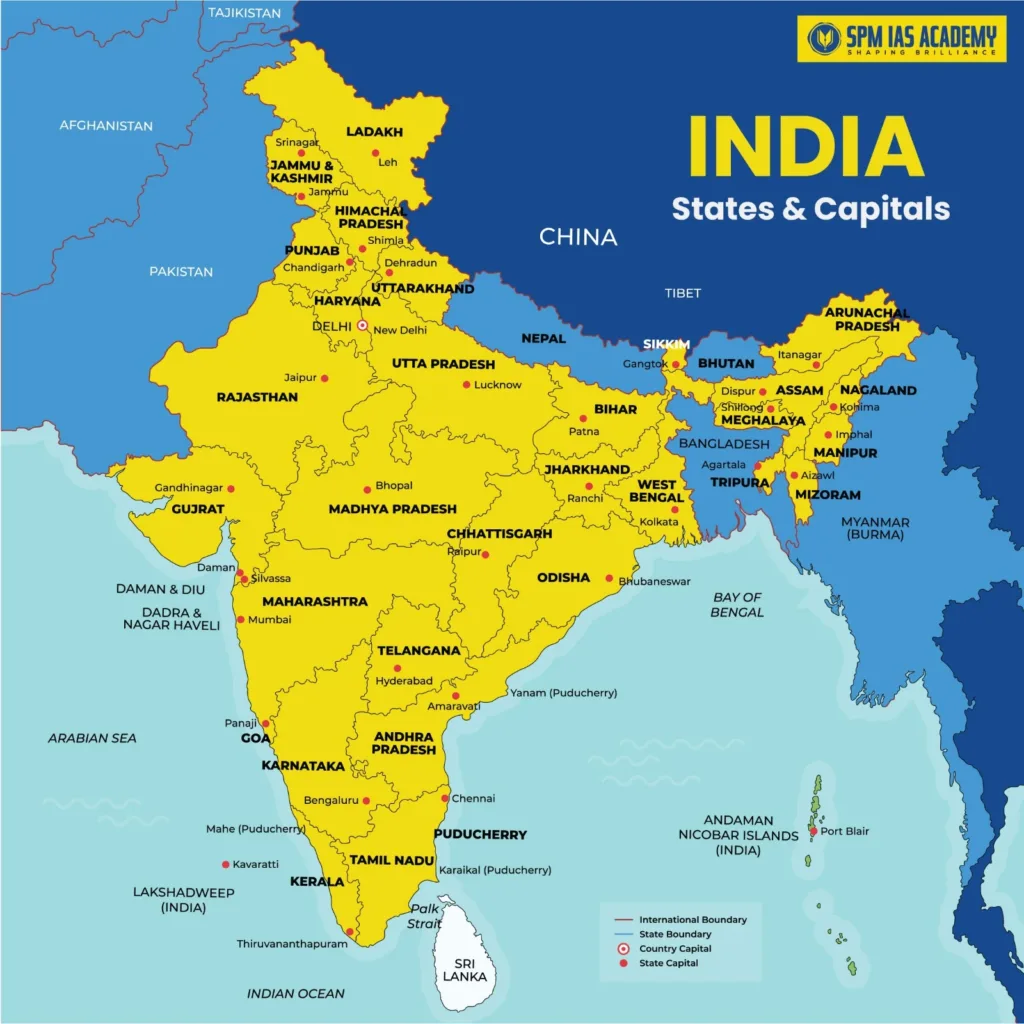
Complete List of 8 Union Territories with Capitals
Union Territories are administered directly by the President of India through a Lieutenant Governor or Administrator. Delhi (NCT) and Puducherry have their own elected assemblies and councils of ministers, while other UTs are under direct Central administration. As of October 31, 2019, India has 8 Union Territories following the bifurcation of J&K.
| S.No | Union Territory | Capital / HQ | Location |
| 1 | Andaman and Nicobar Islands | Port Blair | Bay of Bengal |
| 2 | Chandigarh | Chandigarh | North India |
| 3 | Dadra & Nagar Haveli and Daman & Diu | Daman | West India |
| 4 | Delhi (NCT) | New Delhi | North India |
| 5 | Jammu & Kashmir | Srinagar (Summer) / Jammu (Winter) | North India |
| 6 | Ladakh | Leh | North India |
| 7 | Lakshadweep | Kavaratti | Arabian Sea |
| 8 | Puducherry | Puducherry | South India |
Recent Changes and Key Updates (Exam-Relevant)
Civil services examinations frequently test aspirants on recent administrative and political changes. The following are critical updates that must be memorised:
Jammu & Kashmir and Ladakh (2019)
On October 31, 2019, the State of Jammu & Kashmir was bifurcated into two Union Territories under the Jammu and Kashmir Reorganisation Act, 2019:
- Jammu & Kashmir (with Legislature): Capital — Srinagar (Summer) and Jammu (Winter)
- Ladakh (without Legislature): Capital — Leh (also has Kargil as a major district)
This reduced India’s state count from 29 to 28, and increased the UT count from 7 to 8. This is one of the most important administrative changes in recent decades and is frequently tested in both UPSC and APSC.
Andhra Pradesh Capital Issue
After the bifurcation of Andhra Pradesh and Telangana in 2014, Hyderabad continued as a joint capital for 10 years (until June 2024). Amaravati is the designated capital of Andhra Pradesh as per the AP Capital City Land Acquisition and Development Act, though capital development has been contentious. Aspirants should note:
- Amaravati: Designated Legislative Capital
- Kurnool: Earlier proposed as Judicial Capital
- Visakhapatnam: Earlier proposed as Executive Capital (three-capital model, since revised)
As of 2025, Amaravati is the officially recognised capital. Aspirants must stay updated on any changes during their preparation period.
Uttarakhand — Gairsain as Summer Capital
In 2020, Uttarakhand officially declared Gairsain (in Chamoli district) as its Summer Capital, while Dehradun remains the Winter Capital and the functional capital for administrative purposes. This was a long-standing demand of hill residents who wanted a capital closer to the central hills of the state.
Dadra & Nagar Haveli and Daman & Diu Merger (2020)
On January 26, 2020, the two Union Territories of Dadra & Nagar Haveli and Daman & Diu were merged into a single Union Territory — ‘Dadra and Nagar Haveli and Daman and Diu’ — with Daman as its capital. This reduced the number of UTs from 9 to 8. Himachal Pradesh — Dharamshala as Winter Capital
Himachal Pradesh designated Dharamshala as the state’s second capital (Winter Capital), with Vidhan Sabha sessions held there during winter, while Shimla remains the principal capital.
Northeast India — Special Focus for APSC
For APSC aspirants in particular, a deep understanding of Northeast India’s political geography is indispensable. The Northeast, often called the ‘Seven Sisters’ (with Sikkim sometimes referred to as the ‘Brother’), comprises eight states with distinct cultural, linguistic, and administrative characteristics.
| # | State | Capital | Year Formed | Notable Fact |
| 1 | Assam | Dispur | 1950 (State) | Gateway to NE; Brahmaputra basin; 6th Schedule areas |
| 2 | Arunachal Pradesh | Itanagar | 1987 | Largest NE state; McMahon Line border with China |
| 3 | Manipur | Imphal | 1972 | Loktak Lake (largest freshwater lake in NE) |
| 4 | Meghalaya | Shillong | 1972 | Wettest place on Earth (Mawsynram) is here |
| 5 | Mizoram | Aizawl | 1987 | Highest literacy in NE; hilly terrain |
| 6 | Nagaland | Kohima | 1963 | India’s first state formed on tribal/ethnic basis |
| 7 | Sikkim | Gangtok | 1975 | Nearly surrounded by Bangladesh, rubber plantations |
| 8 | Tripura | Agartala | 1972 | Nearly surrounded by Bangladesh; rubber plantations |
Note: Dispur is the capital of Assam and is an integral part of Guwahati, the largest city in Northeast India. APSC aspirants must note this distinction — Dispur is the seat of the State Government (Assam Secretariat, Raj Bhavan) while Guwahati is the commercial and urban hub.
Special Constitutional Provisions for Northeast States
Many northeastern states enjoy special constitutional protections. Knowledge of these is essential for APSC Mains and Interviews:
- Sixth Schedule (Articles 244(2) and 275(1)): Covers tribal areas in Assam, Meghalaya, Tripura, and Mizoram — provides for Autonomous District Councils (ADCs).
- Article 371(A): Special provisions for Nagaland — Naga customary law and practices are protected.
- Article 371(B): Special provisions for Assam — regarding a committee of legislators from tribal areas of Assam.
- Article 371(C): Special provisions for Manipur — Hill Area Committee of the Legislative Assembly.
- Article 371(F): Special provisions for Sikkim — protecting the rights and interests of Sikkim at the time of merger.
- Article 371(G): Special provisions for Mizoram — protecting Mizo customary law and practices.
- Article 371(H): Special provisions for Arunachal Pradesh — relating to law and order powers of the Governor.
Regional Classification of Indian States
India’s states are often grouped into regions for administrative, developmental, and planning purposes. The National Development Council, NITI Aayog, and various government bodies use regional classifications. The most commonly used classification for UPSC/APSC examinations is as follows:
North India
- States: Haryana, Himachal Pradesh, Punjab, Rajasthan, Uttar Pradesh, Uttarakhand
- UT: Delhi (NCT), Chandigarh, Jammu & Kashmir, Ladakh
- Important capitals: Lucknow (UP), Jaipur (Rajasthan), Shimla/Dharamshala (HP), Dehradun/Gairsain (Uttarakhand)
South India
- States: Andhra Pradesh, Karnataka, Kerala, Tamil Nadu, Telangana
- UT: Puducherry, Lakshadweep, Andaman & Nicobar Islands (often categorised separately)
- Important capitals: Bengaluru, Chennai, Thiruvananthapuram, Hyderabad, Amaravati
East India
- States: Bihar, Jharkhand, Odisha, West Bengal
- Important capitals: Patna, Ranchi, Bhubaneswar, Kolkata
West India
- States: Goa, Gujarat, Maharashtra, Rajasthan (sometimes classified as North)
- UTs: Dadra & Nagar Haveli and Daman & Diu
- Important capitals: Mumbai, Gandhinagar, Panaji, Daman
Central India
- States: Chhattisgarh, Madhya Pradesh
- Important capitals: Bhopal, Raipur
Northeast India (Eight Sisters)
- States: Arunachal Pradesh, Assam, Manipur, Meghalaya, Mizoram, Nagaland, Sikkim, Tripura
- Details covered in Section 6 above
Memory Techniques and Mnemonics for Aspirants
Retaining the capitals of all 28 states and 8 UTs can be challenging. Here are some proven strategies used by toppers:
Grouping by Region
Memorise states in regional clusters — North, South, East, West, Central, Northeast. This reduces the cognitive load and helps in map-based questions.
Association Technique
Associate the state with something memorable about its capital: Bhopal = ‘Bhopal Gas Tragedy’ (MP), Ranchi = ‘MS Dhoni’s hometown’ (Jharkhand), Dispur = ‘Dis-par’ (Assam — near Guwahati), Itanagar = ‘Ita Fort’ (Arunachal Pradesh).
Focus on Tricky Ones
Most exam errors come from a handful of frequently confused capitals. Memorise these carefully:
- Assam → Dispur (NOT Guwahati — Dispur is the capital, Guwahati is the largest city)
- Gujarat → Gandhinagar (NOT Ahmedabad — Gandhinagar is the planned capital)
- Maharashtra → Mumbai (Both the commercial capital of India and the state capital)
- Himachal Pradesh → Shimla (Summer) / Dharamshala (Winter)
- Uttarakhand → Dehradun (Winter) / Gairsain (Summer)
- Jammu & Kashmir → Srinagar (Summer) / Jammu (Winter)
- Arunachal Pradesh → Itanagar (NOT Shillong — Shillong is Meghalaya’s capital)
- Telangana → Hyderabad (shared with AP until June 2024, then exclusively Telangana’s)
Dual/Seasonal Capitals Summary
States with two capitals are a recurring exam topic. Here is a consolidated list:
| State / UT | Summer Capital | Winter Capital | Notes |
| Jammu & Kashmir (UT) | Srinagar | Jammu | Since British era |
| Himachal Pradesh | Shimla | Dharamshala | Official since 2017 |
| Uttarakhand | Gairsain | Dehradun | Declared 2020 |
Historically and Culturally Significant Capitals
Many state capitals carry immense historical significance that may be tested in the culture and heritage section of UPSC/APSC examinations:
- Patna (Bihar): Ancient city of Pataliputra, capital of the Maurya and Gupta Empires. One of the oldest continuously inhabited cities in the world.
- Kolkata (West Bengal): Former capital of British India (until 1911); seat of the Bengal Renaissance; India’s cultural capital.
- Jaipur (Rajasthan): The Pink City, founded in 1727 by Maharaja Jai Singh II; UNESCO World Heritage Site (2019).
- Thiruvananthapuram (Kerala): Named after ‘Anantha’ (Vishnu); one of the oldest cities in South India; Padmanabhaswamy Temple.
- Bhubaneswar (Odisha): Temple city with over 700 temples; planned city designed by German architect Otto Königsberger.
- Bengaluru (Karnataka): The Silicon Valley of India; also known for its pleasant climate and garden city legacy.
- Gangtok (Sikkim): Former capital of the Kingdom of Sikkim; situated at 1,650 m elevation in the Himalayas.
- Shillong (Meghalaya): Often called the ‘Scotland of the East’; one of the few hill stations in Northeast India.
- Kohima (Nagaland): Site of the famous Battle of Kohima (1944) — a turning point in World War II in the Asian theatre.
- Agartala (Tripura): Capital close to the Bangladesh border; known for Ujjayanta Palace.
Planned Capitals of India
Several Indian state capitals were planned cities, designed from scratch — a notable feature that appears in urban planning and geography questions:
- Chandigarh: Designed by Swiss-French architect Le Corbusier after partition necessitated a new capital for Punjab (as Lahore went to Pakistan). Now serves as the joint capital of Punjab and Haryana and is also a UT.
- Gandhinagar: Planned capital of Gujarat, designed on a grid pattern inspired by Chandigarh; named after Mahatma Gandhi.
- Bhubaneswar: Planned capital of Odisha, designed by German architect Otto Königsberger in the 1940s; became the state capital in 1948.
- Naya Raipur (now Atal Nagar): The planned capital district of Chhattisgarh, developed near the original Raipur city as a modern administrative centre.
- Amaravati: Planned new capital of Andhra Pradesh, designed as a greenfield city on the banks of the Krishna River, though construction has faced political and financial hurdles.
- Itanagar: Capital of Arunachal Pradesh; developed as a planned administrative centre in the hilly terrain.
Quick Revision: States by Alphabetical Order
For final revision, here is an alphabetically sorted quick-reference list for all 28 states:
| # | State | Capital | Key Exam Note |
| 1 | Andhra Pradesh | Amaravati | New capital; Hyderabad was joint capital until 2024 |
| 2 | Arunachal Pradesh | Itanagar | Largest NE state by area; McMahon Line border |
| 3 | Assam | Dispur | APSC focus; NOT Guwahati; Sixth Schedule applies |
| 4 | Bihar | Patna | Ancient Pataliputra; Maurya Empire capital |
| 5 | Chhattisgarh | Raipur | Formed in 2000 from MP; tribal heartland |
| 6 | Goa | Panaji | Smallest state by area; former Portuguese colony |
| 7 | Gujarat | Gandhinagar | NOT Ahmedabad; planned capital |
| 8 | Haryana | Chandigarh* | Shares capital (UT) with Punjab |
| 9 | Himachal Pradesh | Shimla/Dharamshala | Dual capital; Shimla was British summer capital |
| 10 | Jharkhand | Ranchi | Formed in 2000 from Bihar; tribal state |
| 11 | Karnataka | Bengaluru | IT capital of India; formerly Bangalore |
| 12 | Kerala | Thiruvananthapuram | Highest HDI state; Padmanabhaswamy Temple |
| 13 | Madhya Pradesh | Bhopal | Largest state by area; heart of India |
| 14 | Maharashtra | Mumbai | Most populous city; financial capital |
| 15 | Manipur | Imphal | Polo originated here; Loktak Lake |
| 16 | Meghalaya | Shillong | Wettest region; ‘Scotland of the East’ |
| 17 | Mizoram | Aizawl | Highest literacy in NE; bamboo forests |
| 18 | Nagaland | Kohima | Battle of Kohima (WWII); tribal customary law |
| 19 | Odisha | Bhubaneswar | Temple city; planned capital |
| 20 | Punjab | Chandigarh* | Shares UT capital with Haryana |
| 21 | Rajasthan | Jaipur | Largest state by area; Pink City; Thar Desert |
| 22 | Sikkim | Gangtok | Youngest NE state (1975); smallest NE state |
| 23 | Tamil Nadu | Chennai | 4th largest state economy; classical Tamil culture |
| 24 | Telangana | Hyderabad | Newest state (2014); IT hub; Cyberabad |
| 25 | Tripura | Agartala | Surrounded by Bangladesh on 3 sides |
| 26 | Uttar Pradesh | Lucknow | Most populous state; Nawabi culture; Ganga-Yamuna Doab |
| 27 | Uttarakhand | Dehradun/Gairsain | Dev Bhumi; Gangotri, Badrinath glaciers |
| 28 | West Bengal | Kolkata | Cultural capital; partition history; Sundarbans |
Exam Tips and Frequently Asked Questions
The following types of questions on this topic appear regularly in UPSC Prelims and APSC Prelims. Use this as a self-assessment checklist:
Frequently Asked Question Patterns
- Which state capital is located within another city? → Dispur (within Guwahati, Assam)
- Which UT serves as the capital of two states? → Chandigarh (Punjab and Haryana)
- Which was the last state to be carved out of an existing state? → Telangana (2014), carved out of Andhra Pradesh
- How many states and UTs does India have? → 28 States + 8 Union Territories
- Which state was bifurcated into two UTs in 2019? → Jammu & Kashmir → J&K (UT with Legislature) + Ladakh (UT without Legislature)
- Name the Union Territory with the largest area → Ladakh
- Which state has no official capital city? → All states have capitals, but note Chandigarh as a UT serves as the capital of two states
- Which NE state was the first to be formed on ethnic/tribal lines? → Nagaland (1963)
- Gairsain is the summer capital of which state? → Uttarakhand
- What is the winter capital of Jammu & Kashmir? → Jammu
Common Mistakes to Avoid
- Confusing Dispur with Guwahati: Dispur is the CAPITAL of Assam; Guwahati is the largest city and commercial hub.
- Confusing Gandhinagar with Ahmedabad: Gandhinagar is the planned CAPITAL of Gujarat; Ahmedabad is the largest city.
- Treating J&K as a state: Since 2019, it is a Union Territory (with a legislature). Ladakh is a UT without a legislature.
- Outdated capital of Andhra Pradesh: Hyderabad was the joint capital until 2024; Amaravati is now the official capital.
- Calling Puducherry ‘Pondicherry’ in formal answers: The official name was changed to Puducherry in 2006.
- Forgetting Dadra & Nagar Haveli and Daman & Diu merger (2020): It is now ONE UT, not two.
Enroll in UPSC coaching in north east India for structured and region-focused preparation.
come.
States and Capitals of India 2025 – Top 5 States in Sex Ratio
- Kerala: 1084 women per 1000 men (Highest in India)
- Puducherry: 1038 women per 1000 men
- Tamil Nadu: 995 women per 1000 men
- Andhra Pradesh: 992 women per 1000 men
- Chhattisgarh: 991 women per 1000 men
- Manipur: 987 women per 1000 men (Closely following)

States and Capitals of India 2025 – Top 5 States in Literacy Rate
- Kerala: 94% literacy (Highest in India)
- Mizoram: 91% literacy
- Delhi: 89% literacy
- Goa: 88% literacy
- Himachal Pradesh: 87% literacy

States and Capitals of India 2025 – Top 5 States in Area
- Rajasthan: 342,239 sq. km (Largest state by area)
- Madhya Pradesh: 308,252 sq. km
- Maharashtra: 307,713 sq. km
- Uttar Pradesh: 240,928 sq. km
- Gujarat: 196,024 sq. km

Tips for Memorizing Indian States and Capitals
Even though the list appears long, certain strategies can be adopted to memorize the Indian States and Capitals effectively:
- Flashcards can be used to test yourself daily.
- Mnemonic devices should be created for tricky names.
- Maps should be labelled and revised frequently.
- Grouping by region (North, South, East, West, Northeast) can aid retention.
Conclusion
A thorough knowledge of Indian states, their capitals, regional classifications, and recent administrative changes is not just a prerequisite for scoring well in Civil Services examinations — it is the foundation upon which a deeper understanding of Indian geography, economy, governance, and culture is built. For UPSC aspirants, this topic intersects with Physical Geography (river basins, mountain ranges), Indian Polity (special constitutional provisions, statehood), Economy (regional development, NITI Aayog zones), and Current Affairs.
For APSC aspirants, the Northeast region — especially Assam and its relationship with the other seven sister states — deserves focused and sustained attention. The region’s unique constitutional protections, the Sixth Schedule, Article 371 variants, and the evolving security and developmental landscape are all directly connected to the administrative geography covered in this guide.
Regular revision using the tables and mnemonics provided in this guide, combined with map-based study and current affairs monitoring, will ensure that aspirants can confidently handle any question on this topic across all stages of the examination.
Aspirants aiming to improve answer writing, receive expert feedback, and develop a structured preparation strategy can explore the UPSC Mains Mentorship Program offered by SPM IAS Academy.
Best of luck to all UPSC and APSC aspirants!
Also read : India’s River System 💧
Conclusion
To conclude, you need to adopt a strategic and systematic approach to memorize the Indian State and Capital. Since this knowledge plays a critical role in school curricula, civil service exams, and public discourse, it should not be ignored. With updated data, regular revision, and visual aids, you can have complete command over Indian geography.
Citations
- States and Union Territories
- Indian States
- Different Dance Forms Of India With States
- List of India’s 8 union territories and their capitals
- States with the Highest Sex Ratio
- Population
Frequently Asked Questions (FAQs) on Indian State and Capital 2025
There are 28 states listed across the country.
There are 8 union territories in India
Mumbai is the capital of Maharashtra.
Telangana is the newest state in India, formed in 2014.
As of 2025, India has 28 states and 8 Union Territories. Jammu and Kashmir was reorganized into two Union Territories in 2019, reducing the total number of states from 29 to 28.
Yes, Dadra and Nagar Haveli and Daman and Diu were merged into one union territory in 2020, as reflected in Indian States and Capitals 2025.

Behind every article at SPM IAS Academy is a team of skilled content writers and subject experts committed to making preparation easier for aspirants. From answering common doubts to breaking down complex issues and current affairs, we create content that is accurate, easy to understand, and directly useful for UPSC, APSC, and other competitive exams.