
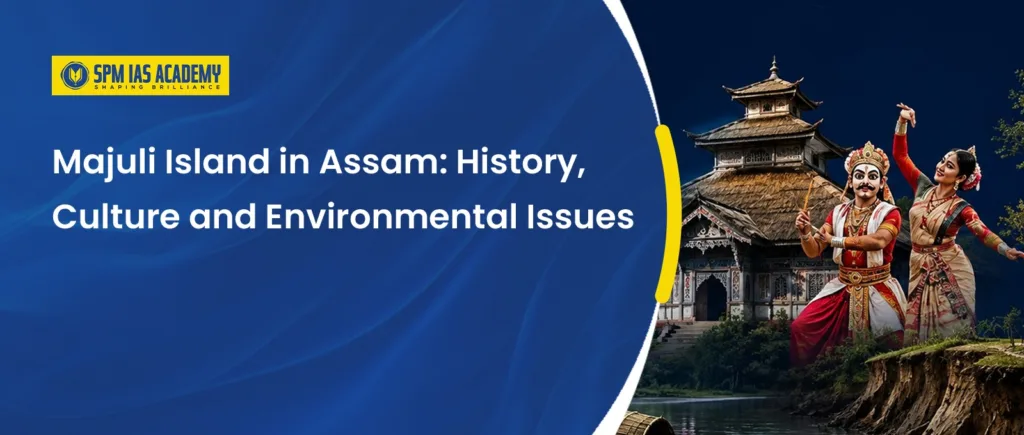
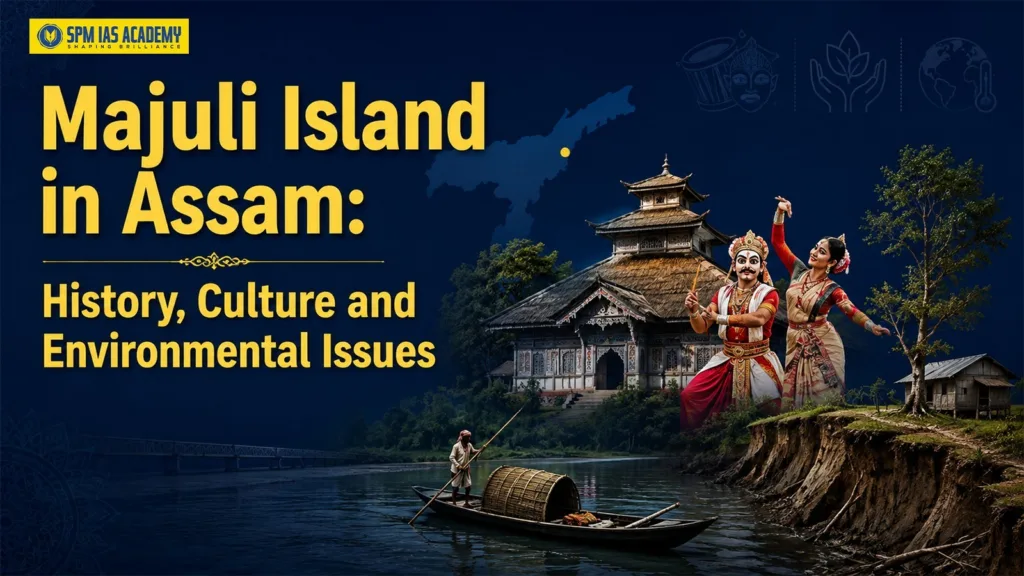
Majuli Island is a unique river island in Assam. It lies in the middle of the mighty Brahmaputra River. The island is famous for its peaceful villages, green fields, wetlands, monasteries and traditional arts. It is also an important centre of Assamese Neo-Vaishnavite culture. However, the island faces many environmental challenges. Annual floods, riverbank erosion and changing river channels are reducing its land area. Many families have lost their homes and farms. Therefore, protecting Majuli is important for Assam’s culture, history and natural environment.
This article explains the island’s location, historical development, people, traditions, religious institutions, and environmental problems. It also discusses the key measures needed to protect this valuable part of Assam, including environmental conservation, sustainable development, responsible tourism, and preservation of its cultural heritage. For aspirants preparing through a Guwahati IAS Academy, this topic is particularly useful for understanding Assam’s geography, history, culture, environment, and regional current affairs.
Where Is the Island Located?
Majuli is located in the upper Brahmaputra Valley of Assam and is surrounded by the Brahmaputra River and its various channels. The main Brahmaputra flows along its southern side, while the Kherkutia Xuti and the Subansiri River form important waterways along the northern side. This unique riverine setting has shaped Majuli’s geography, settlement patterns, agriculture, and cultural life over time. For students taking APSC online classes, Majuli is an important topic under Assam Geography, Environment, Culture, and regional current affairs.
The island is connected to Jorhat through regular ferry services. Visitors usually travel to Nimati Ghat and then take a ferry across the river. The journey offers beautiful views of the Brahmaputra, fishing boats, and distant riverbanks.
Majuli Island became India’s first island district in 2016. Before that, it was a subdivision of Jorhat district. The decision gave Majuli its own district administration. It also helped the government focus more closely on local development and environmental problems.
Majuli is widely described as one of the world’s largest inhabited river islands. However, its exact area changes because of riverbank erosion and the movement of river channels. According to historical records, Majuli once covered a much larger area. Over time, the Brahmaputra has washed away a large portion of its land.
The island contains many villages, rice fields, wetlands, small streams and grazing areas. Water plays a major role in people’s daily lives. It supports farming, fishing and transport. At the same time, it also creates serious risks during the monsoon season.
Formation of the River Island
Majuli was formed through the changing courses of the Brahmaputra and its tributaries over long periods. Rivers continuously transport water, sand, silt, soil, and other sediments, depositing these materials in some areas while eroding land in others. These processes of river deposition and erosion gradually shaped the island’s landscape and continue to influence its size and geography today. Understanding these geographical processes is important for aspirants preparing through UPSC coaching in North East India, particularly for topics related to river systems, erosion, sedimentation, and the physical geography of Assam.
Over hundreds of years, this process created sandbars and new stretches of land. Several smaller land areas later joined together. As a result, a large river island was formed.
Earthquakes also affected Majuli’s shape. The great Assam earthquake of 1950 caused major changes in the Brahmaputra Valley. It raised the riverbed in certain places and increased the amount of soil carried by the river. After the earthquake, floods and erosion became more severe in many parts of the island.
Therefore, Majuli is not a fixed piece of land. It is part of a living river system. Its size, shape and river channels continue to change.
History of Majuli Island
The history of Majuli Island is closely connected with the Brahmaputra River, the Ahom kingdom and the Neo-Vaishnavite movement. People have lived in this region for many centuries. They learned to build houses, grow crops and travel according to the changing behaviour of the river.
Majuli became an important religious and cultural centre during the 15th and 16th centuries. At that time, the great Assamese saint Srimanta Sankardeva started the Neo-Vaishnavite movement. His teachings promoted devotion to one God, social harmony and a simple form of worship.
Sankardeva used songs, dance, drama and storytelling to spread his message. These methods made religious ideas easier for ordinary people to understand. His disciple Madhavdeva continued this work and helped the movement reach different parts of Assam.
Their followers later established religious centres called Satras. These centres became places of prayer, education, art and community life. Over time, Majuli developed into one of the main centres of Neo-Vaishnavite learning.
The island was also important during the Ahom period. Several Ahom kings supported religious institutions by providing land and other resources. Because of this support, the monasteries preserved old manuscripts, royal objects, weapons, masks and religious items.
However, Majuli also experienced periods of conflict, migration and natural disaster. Floods forced settlements to move from one place to another. Some religious institutions were also shifted because their original land was washed away.
Even after these difficulties, the island remained an important centre of Assamese identity. Its historical importance can still be seen in its prayer halls, festivals, manuscripts, dances and traditional crafts.
Communities and Village Life
Different communities live together on the island, making Majuli a culturally diverse region of Assam. These include the Mising, Deori, Sonowal Kachari, and other Assamese communities. Each group has its own language, traditional clothing, food, festivals, beliefs, and social customs, while their shared life on the island has also encouraged cultural interaction and coexistence. This rich cultural diversity makes Majuli an important topic for students preparing through APSC coaching online Guwahati, particularly in Assam history, culture, tribal communities, and regional studies.
The Mising community forms a large part of the island’s population. Many Mising families traditionally build raised houses called chang ghars. These houses stand on wooden or bamboo posts. The raised structure helps protect people, food and household items during moderate floods.
Agriculture is one of the main occupations. Rice is the most important crop. Farmers also grow mustard, pulses, vegetables and seasonal fruits. However, farming depends heavily on rainfall, soil quality and flood conditions.
Fishing is another important source of food and income. Local people catch fish from rivers, streams and wetlands. They use different types of nets, traps and boats. In addition, many families raise cattle, goats, pigs, ducks and chickens.
Village life is closely connected with nature. People understand changes in water levels, rainfall and river currents. This traditional knowledge helps them prepare for floods. However, stronger floods and faster erosion are making older methods less effective.
Culture of Majuli
The culture of Majuli is colourful, diverse, and closely connected with religion, agriculture, and community life. Music, dance, theatre, festivals, traditional crafts, and handloom work form an important part of the island’s cultural identity. Many of these traditions are preserved through community participation and passed from one generation to the next through families and local institutions. For aspirants preparing through an APSC course online, Majuli’s cultural traditions are important for understanding Assam’s heritage, performing arts, indigenous communities, and regional culture.
The Mising community celebrates Ali-Aye-Ligang, an important farming festival. It marks the beginning of seed-sowing. During the festival, people perform the Gumrag dance, sing traditional songs and prepare special dishes. Young people wear colourful handwoven clothes and visit different homes.
Weaving is an important skill among local women. They produce beautiful mekhela chadors, shawls, jackets and traditional garments. The designs often show patterns inspired by nature and community life.
The island is also famous for pottery. In some villages, potters shape clay by hand instead of using a wheel. They prepare cooking vessels, water pots and other household items. This old method reflects the island’s close relationship with its natural resources.
Bamboo and cane are widely used to make houses, baskets, fishing tools, mats and furniture. Boat-making is another valuable skill because boats are essential for transport and fishing.
Food is also an important part of local identity. Rice, fish, leafy vegetables, herbs and locally available ingredients are commonly used. Many dishes are simple, fresh and connected with the farming seasons.
Therefore, Majuli’s traditions are not limited to festivals. They can be seen in houses, clothes, food, farming, art and everyday village life.
Satras of Majuli
The Satras of Majuli are religious and cultural institutions linked to the Assamese Neo-Vaishnavite movement. A Satra usually contains a prayer hall called a Namghar. It may also have a sacred area called the Manikut, living spaces and rooms for cultural activities.
However, these institutions are not only places of worship. They also teach music, dance, drama, literature and discipline. In this way, they work like living cultural schools.
Some of the best-known institutions include:
- Auniati Satra: It preserves old manuscripts, religious objects and other historical items. It is also known for traditional festivals and devotional practices.
- Dakhinpat Satra: It is famous for the Raas Mahotsav. Large performances based on the life of Lord Krishna are organised here.
- Garamur Satra: It is known for performing arts, historical objects and cultural learning. It also has an important place in the island’s religious life.
- Kamalabari Satra: It has made major contributions to Sattriya dance, music, literature and classical studies.
- Samaguri Satra: It is widely known for traditional mask-making. Its artists have helped introduce Majuli’s masks to audiences across India and abroad.
Many of these institutions have faced erosion. As a result, some had to move from their original locations. Their movement shows how environmental problems can directly threaten cultural heritage.
Mask-Making and Bhaona Theatre
Traditional mask-making is one of Majuli’s most remarkable art forms. Artists use bamboo, clay, cloth, cow dung and natural colours to create masks. The process requires patience and a deep understanding of character design.
The masks represent gods, demons, animals and figures from religious stories. Some masks cover only the face. Others cover the head or the entire body. Moving parts may also be added to make the characters appear more lively.
These masks are mainly used in Bhaona, a traditional form of theatre introduced by Srimanta Sankardeva. Bhaona combines acting, music, dance, dialogue and moral lessons. It presents stories from Indian religious texts in a form that local audiences can understand.
Mask-making is now gaining wider attention. However, artisans still face problems such as limited income, shortage of materials and a lack of permanent markets. Therefore, supporting young artists is necessary to keep this tradition alive.
Sattriya Dance, Borgeet and Festivals
Sattriya dance began inside the religious institutions of Assam. It was first performed as part of devotional practices and theatre. Today, it is recognised as one of India’s classical dance forms.
The dance uses controlled body movements, hand gestures, facial expressions and traditional costumes. Each performance tells a story or expresses devotion. Drums, cymbals and other instruments provide rhythm.
Borgeet is another important cultural tradition. These devotional songs were composed mainly by Sankardeva and Madhavdeva. They are sung in a special style during prayers and cultural performances.
Raas Mahotsav is one of the island’s largest festivals. It usually presents events from the life of Lord Krishna. Villages and religious centres organise plays, dances and colourful displays. Local residents take part as performers, musicians, costume makers and volunteers.
Tourists from different parts of India visit during the festival. Consequently, the event supports local transport, food stalls, shops and homestays. However, tourism must be managed carefully so that waste, noise and overcrowding do not damage the local environment.
Majuli Island Erosion and Environmental Problems
Majuli Island erosion is the greatest threat to the region. During the monsoon, the Brahmaputra carries a huge amount of water, sand and soil. Its strong currents strike the riverbanks and remove layers of land.
As a result, houses, schools, roads, farms and places of worship may be washed away. In some cases, entire villages have had to move. Families who lose their land may be forced to settle in temporary areas or move outside the island.
Erosion also creates social problems. When a family loses farmland, it may also lose its main source of income. Children may have to change schools. People can also lose community networks, local markets and places connected with family memories.
Historical records show that Majuli once covered a much larger area. The District Disaster Management Plan states that the island covered about 1,250 square kilometres in 1853. However, a large part of that area was later lost. Erosion became more severe after the earthquake of 1950.
Therefore, land loss is not only a geographical problem. It affects the economy, society, culture, and future of local communities.
Annual Floods
Flooding is a natural part of the Brahmaputra river system. Moderate floods can bring fresh soil and support agriculture. They can also fill wetlands and help fish reproduce.
However, severe floods cause major damage. Water can enter houses, destroy crops, and wash away roads. Schools and health centres may become difficult to reach. Livestock, food grains and household items can also be lost.
Majuli Island faces floods almost every year. Local people have developed different ways to live with them. Raised houses, boats, community shelters and stored food are common forms of preparation.
Yet the pattern of flooding is becoming less predictable. Sudden rises in water levels leave families with little time to move. Damaged embankments can also allow water to enter large areas quickly.
After the floodwater goes down, people face other problems. Drinking-water sources may become dirty. Diseases may spread, and farmers may need money to buy seeds again. Therefore, flood management must include rescue, healthcare, clean water and support for rebuilding livelihoods.
Climate Change and Changing Weather
Climate change can make environmental risks more difficult to manage. Changes in rainfall may lead to stronger floods in some years and water shortages in others. Extreme weather events can also damage crops and increase pressure on riverbanks.
Warmer temperatures may affect wetlands, fish populations and farming seasons. Farmers may find it harder to decide when to sow seeds. In addition, heavy rainfall within a short period can create sudden flooding.
A scientific study highlighted Majuli’s exposure to repeated floods, land loss, deforestation and growing human pressure. Therefore, future planning must consider both present river behaviour and long-term climate risks.
Local weather information should reach farmers and boat operators quickly. Better forecasting can help people protect crops, livestock and fishing equipment before dangerous conditions develop.
Wetlands and Biodiversity
Majuli has many wetlands, locally known as beels. These water bodies support fish, frogs, insects, plants and birds. Some wetlands also attract migratory birds during the winter.
Wetlands act like natural storage areas. They hold extra rainwater and floodwater. As a result, they can reduce pressure on nearby settlements. They also support fishing and provide water for animals.
However, wetlands are being affected by soil deposits, pollution and changes in land use. Some become shallow when too much sand and silt collect inside them. Others are filled for construction or farming.
The cutting of trees and riverbank plants can make the soil weaker. Plastic waste and chemical pollution can also damage water quality. Therefore, protecting wetlands is an important part of protecting the entire island.
Livelihood and Development Challenges
Most families depend on farming, fishing, weaving, crafts, livestock and small businesses. These activities are closely linked with land and water. Therefore, floods and erosion directly affect household income.
Transport is another challenge. Ferries remain important for carrying people, vehicles and goods. During bad weather, services may be delayed or stopped. This affects students, patients, workers and traders.
Healthcare services are available, but reaching them can be difficult from remote villages. Flooded roads and long ferry journeys can delay medical treatment.
Education is also affected when schools are damaged or used as relief shelters. Children from displaced families may struggle to continue their studies.
At the same time, careless development can create new environmental pressure. Roads, buildings and tourism facilities should not block natural water channels. Development plans must respect the island’s river-based environment.
Tourism and Responsible Travel
Majuli attracts visitors because of its monasteries, festivals, village life, masks and natural beauty. Tourism creates income for homestays, guides, boat operators, drivers, restaurants and craft sellers.
However, rapid tourism can create plastic waste, noise and pressure on local resources. Visitors should avoid littering and respect religious spaces. They should also seek permission before photographing ceremonies or people.
Buying directly from local artisans can support traditional skills. Staying in locally managed homestays also allows money to remain within the community.
Thus, responsible tourism can help protect culture while creating employment. It should remain small-scale, respectful and environmentally friendly.
How Can Majuli Island Be Protected?
Protecting Majuli Island requires a combination of engineering, environmental planning and community action. Embankments and riverbank barriers can protect important settlements. However, they must be based on proper scientific studies.
Poorly planned barriers may push strong currents towards another village. Therefore, experts must study the entire river system instead of focusing on only one location.
Trees, bamboo and local grasses can help hold the soil together. Wetlands should be restored so that they can store excess water. Natural drainage channels should not be blocked by roads or buildings.
Flood warnings must reach every village on time. Community shelters should have clean water, toilets, food, medicines and safe spaces for children and older people.
Traditional raised houses can reduce damage in flood-prone areas. Farmers should also receive flood-resistant seeds, crop insurance and support after disasters.
Most importantly, local residents must be involved in planning. They understand changes in water levels, river channels and seasons. Their knowledge can make scientific and government programmes more practical.
Cultural institutions, masks, manuscripts and historical objects also need protection plans. Digital records can preserve information, but original objects must be stored safely.
Why Majuli Matters
Majuli Island represents a special relationship between people, culture and nature. It preserves Assamese religious traditions, classical dance, theatre, handloom work, pottery and mask-making. It is also home to several communities with rich local knowledge.
The island has been included on India’s UNESCO World Heritage Tentative List because of its cultural importance. However, it has not yet received final World Heritage status.
Protecting Majuli is not only about saving land. It is also about saving languages, traditional skills, festivals, memories and community life. If the island continues to lose land, Assam may also lose an important part of its living heritage.
Conclusion
Majuli Island is one of Assam’s greatest natural and cultural treasures. Its river landscape, religious centres, indigenous communities, festivals and traditional arts make it truly special.
However, the island faces serious threats from floods, erosion, climate change, habitat loss and unplanned development. These problems affect homes, farms, schools, livelihoods and cultural institutions.
Therefore, the government, scientists, local communities and visitors must work together. Strong flood protection, wetland conservation, early warnings and responsible tourism can help. At the same time, traditional knowledge must be respected.
With careful planning and community participation, Majuli’s land and heritage can be protected for future generations.
Frequently Asked Questions
Q1. Why is Majuli important to Assam?
Majuli is important because it is a major centre of Assamese Neo-Vaishnavite culture. Its monasteries preserve Sattriya dance, Bhaona, devotional music, masks and manuscripts. The island also supports indigenous communities, farming, fishing, wetlands and wildlife. Therefore, it has great historical, cultural, social and environmental value.
Q2. What is the main environmental problem faced by Majuli?
Riverbank erosion is its most serious environmental problem. Strong Brahmaputra currents remove land, especially during the monsoon. Consequently, houses, farms, roads and villages can disappear. Regular floods, shifting river channels, loss of vegetation and changing weather patterns can increase the damage and force families to relocate.
Q3. What are Satras, and why are they important?
Satras are religious and cultural centres linked to the Neo-Vaishnavite movement of Srimanta Sankardeva. They provide spaces for prayer, learning and community activities. Moreover, they preserve Sattriya dance, Bhaona theatre, devotional music, masks, manuscripts and historical objects. Thus, they help keep Assam’s cultural heritage alive.
Also Read

Behind every article at SPM IAS Academy is a team of skilled content writers and subject experts committed to making preparation easier for aspirants. From answering common doubts to breaking down complex issues and current affairs, we create content that is accurate, easy to understand, and directly useful for UPSC, APSC, and other competitive exams.