
Atal Amrit Abhiyan is a flagship health assurance scheme launched by the Government of Assam on 25 December 2016 to provide affordable and cashless healthcare to poor and low-income families. It mainly targets BPL and low-income APL households and covers high-cost treatment for critical diseases. Therefore, the scheme plays an important role in reducing out-of-pocket health expenditure among poorer sections of society.
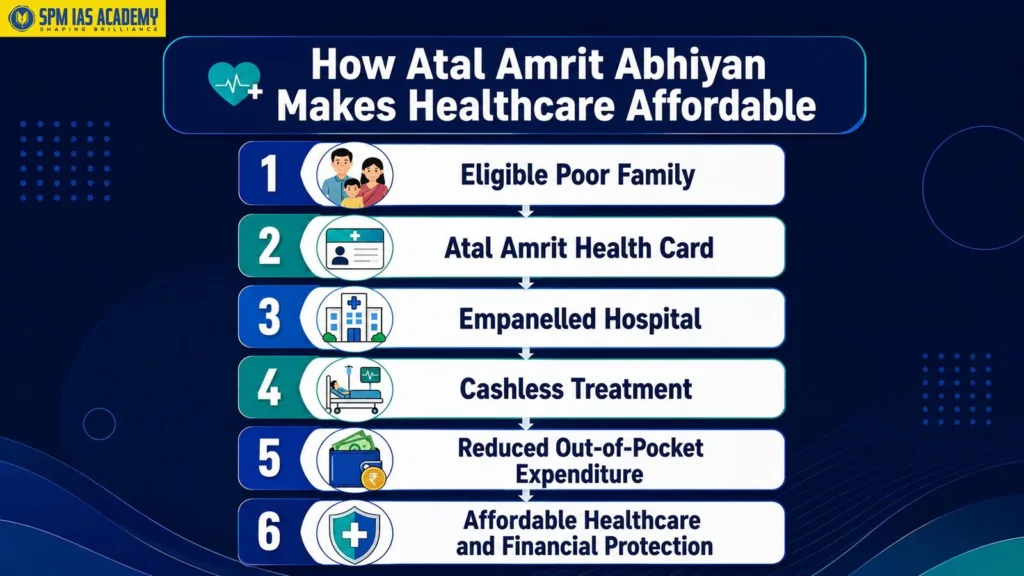
Atal Amrit Abhiyan has made healthcare affordable through the following ways:
1. Cashless Treatment for Critical Illnesses
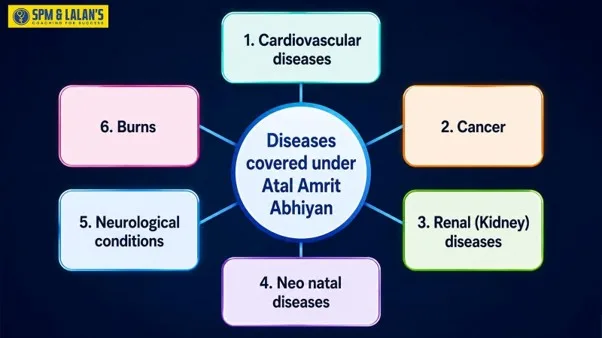
The scheme provides cashless inpatient treatment up to ₹2 lakh per individual member per year in empanelled public and private hospitals within and outside Assam. It covers major high-cost disease groups such as:
- Cardiovascular diseases
- Cancer
- Kidney diseases
- Neurological conditions
- Neonatal diseases
- Burns
This is significant because these diseases often push poor families into debt. By covering expensive procedures, the scheme protects families from catastrophic health expenditure. The NHM Assam portal notes that the scheme covers 438 procedures under these six disease groups.
2. Support to BPL and Low-Income APL Families
The scheme covers BPL families free of cost and extends support to APL families with annual income up to ₹5 lakh, excluding government employees. Thus, it benefits not only the poorest but also the vulnerable lower-middle-income population that may not afford private treatment.
3. Access to Empanelled Hospitals
Atal Amrit Abhiyan allows beneficiaries to receive treatment in empanelled hospitals, including selected hospitals outside Assam. This improves access to specialised care for diseases such as cancer, cardiac ailments and kidney disorders, which may not be available in every district.
4. Reduction of Out-of-Pocket Expenditure
In Assam, many poor families depend on daily wages and informal work. A single critical illness can force them to sell land, borrow money or discontinue treatment. The scheme reduces this burden by directly covering treatment costs.
5. Health Card and Identification System
The scheme provides health cards and unique identification to eligible beneficiaries. This improves transparency, simplifies hospital access and reduces dependence on middlemen.
Critical Analysis of Effectiveness
Despite its benefits, the scheme faces some limitations:
- The coverage of ₹2 lakh may be inadequate for advanced cancer, cardiac surgery or long-term kidney treatment.
- Awareness remains low among remote rural, char and tea garden communities.
- Many beneficiaries still face travel, food and accommodation costs during treatment.
- Empanelled hospital availability remains uneven across districts.
- Delays in claim settlement and administrative issues may affect service delivery.
- The scheme focuses mainly on tertiary care and does not fully address preventive and primary healthcare.
Conclusion
Thus, Atal Amrit Abhiyan has made healthcare more affordable for poorer sections by providing cashless treatment for critical diseases, reducing financial distress and improving access to specialised hospitals. However, its effectiveness can increase further through wider awareness, stronger district-level hospitals, faster claim settlement, higher coverage limits and better integration with Ayushman Bharat and primary healthcare services.