
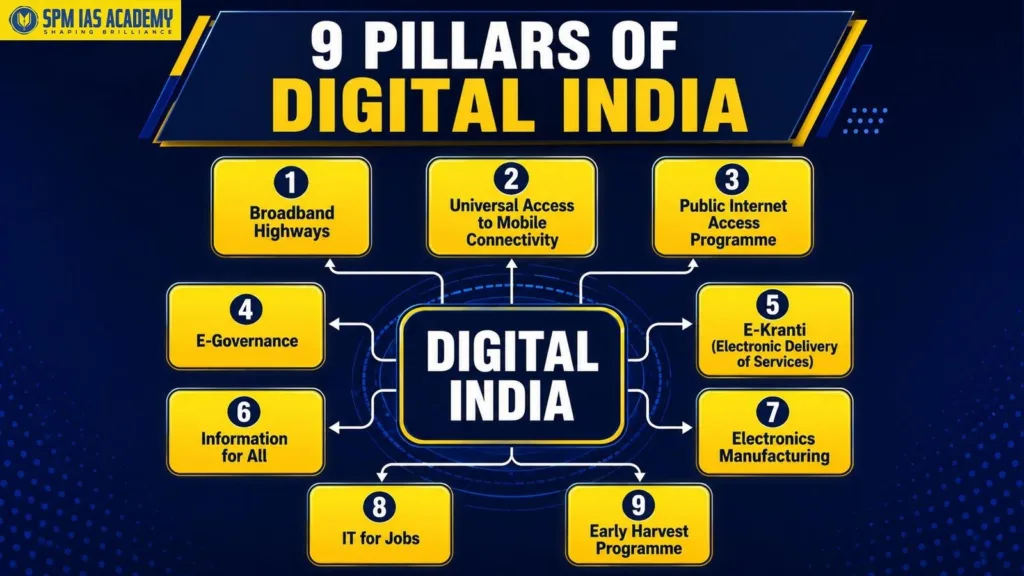
Digital India is a flagship programme of the Government of India that aims to transform India into a digitally empowered society and knowledge economy. Its core objective is to use technology for better governance, inclusive development and citizen-centric service delivery. The programme focuses on three broad vision areas: digital infrastructure as a utility to every citizen, governance and services on demand, and digital empowerment of citizens.
The major focus areas of Digital India include the following:
- Digital infrastructure for every citizen: The programme promotes digital identity, mobile connectivity, internet access, cloud storage and secure digital platforms. For example, Aadhaar, DigiLocker and BharatNet have helped citizens access services digitally.
- Governance and services on demand: Digital India aims to make government services available online in a transparent and time-bound manner. For instance, e-District services, UMANG, online certificates, digital payments and DBT have reduced physical visits to government offices.
- Digital empowerment of citizens: It focuses on digital literacy, access to digital resources and availability of services in Indian languages. Moreover, initiatives like PMGDISHA and CSCs help rural citizens use digital services.
- Public Internet Access Programme: This is one of the important pillars of Digital India. It aims to expand internet-enabled service delivery through Common Services Centres and post offices. The official Digital India portal lists “Public Internet Access Programme” among the nine pillars of Digital India.
- E-governance and e-Kranti: Digital India promotes electronic delivery of services in areas like health, education, agriculture, justice, banking and welfare schemes.
Common Services Centres 2.0 is an important initiative under Digital India. It was approved in 2015 to create a self-sustaining network of CSCs at the Gram Panchayat level. The project aims to establish at least one CSC in 2.5 lakh Gram Panchayats across India for delivery of citizen-centric services.
Important provisions of CSC 2.0 include:
- Gram Panchayat-level coverage: CSC 2.0 seeks to provide at least one CSC in every Gram Panchayat. This improves last-mile service delivery in rural India.
- Single digital service platform: It provides a large bouquet of e-services through one technological platform. These include certificates, banking, insurance, telemedicine, education, utility payments and government scheme services.
- Self-sustaining model: CSC 2.0 follows a transaction-based and service delivery-based model. Therefore, Village Level Entrepreneurs can earn income while delivering public services.
- Digital inclusion: CSCs bridge the rural-urban digital divide by helping citizens access online services even without personal internet access or digital skills.
- Rural entrepreneurship: The scheme creates employment and entrepreneurship opportunities for local youth, especially in rural areas.
Conclusion:
Therefore, Digital India has shifted governance from physical offices to digital platforms. Moreover, CSC 2.0 strengthens this vision by taking digital services to the village level. It promotes transparency, inclusion, entrepreneurship and last-mile governance, making it highly relevant for India’s inclusive development.