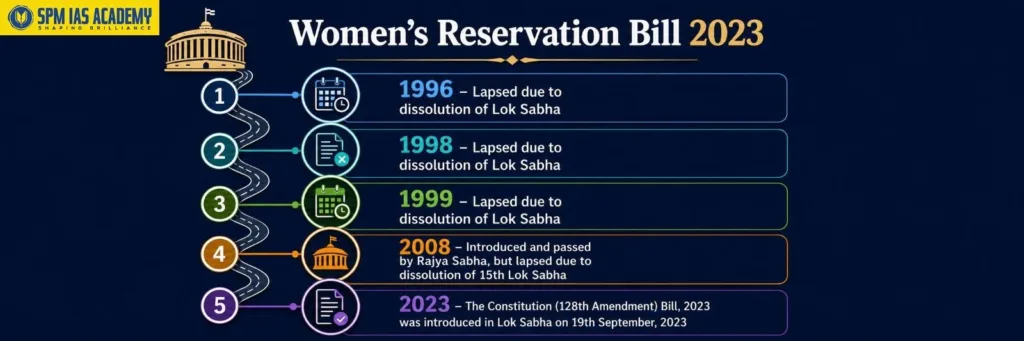
The Constitution (One Hundred and Sixth Amendment) Act, 2023, popularly known as the Nari Shakti Vandan Adhiniyam or the Women’s Reservation Bill, was introduced in the Lok Sabha on 19 September 2023 during a special session of Parliament. The Lok Sabha passed the bill with 454 votes in favour and only two against on 20 September 2023, and the Rajya Sabha passed it unanimously with 214 votes in favour on 21 September 2023. President Droupadi Murmu granted her assent on 28 September 2023.
Key Provisions of the Women’s Reservation Bill, 2023
(a) One-Third Reservation:
The Bill reserves, as nearly as may be, one-third of all seats for women in the Lok Sabha, state legislative assemblies, and the Legislative Assembly of the National Capital Territory of Delhi. This will also apply to seats reserved for SCs and STs in Lok Sabha and state legislatures.
(b) Rotation of Reserved Seats
Instead of keeping the same constituencies reserved permanently, the reserved seats will change after each delimitation exercise — a process in which constituency boundaries are redrawn based on population data from the census. This system is intended to ensure fairness and avoid long-term political control over a single reserved seat.
(c) Duration of Reservation
The reservation will be provided for a period of 15 years. However, it shall continue till such date as determined by a law made by Parliament.
(d) Commencement of Reservation
The reservation will be effective after the census conducted after the commencement of this Bill has been published. Based on the census, delimitation will be undertaken to reserve seats for women.
(e) Extension to Union Territories
In December 2023, Parliament passed bills extending the reservation to the legislative assemblies of Puducherry and Jammu & Kashmir, addressing their initial exclusion.
Constitutional Changes Introduced
The Act introduces several new constitutional provisions:
(a) Article 330A — Reservation in Lok Sabha
Article 330A mandates one-third of Lok Sabha seats, including those reserved for Scheduled Castes (SCs) and Scheduled Tribes (STs), to be reserved for women, following Article 330’s framework for SC/ST reservations. Seats will rotate after each delimitation exercise.
(b) Article 332A — Reservation in State Legislative Assemblies
Article 332A requires one-third of seats in state legislative assemblies to be reserved for women, including within SC/ST quotas, allocated rotationally post-delimitation.
(c) Amendment to Article 239AA — Reservation for Delhi
A new clause under Article 239AA extends the 33% reservation to the Delhi Legislative Assembly, ensuring consistency with state assemblies.
(d) Article 334A — Commencement and Duration
- Article 334A (1) specifies that the reservation “shall come into effect after an exercise of delimitation is undertaken for this purpose after the relevant figures for the first census taken after commencement of the Constitutional Amendment Act have been published.”
- Article 334A (2) allows Parliament to continue the provisions beyond the initial 15-year sunset period, while Article 334A (3) stipulates that seats reserved for women will be rotated after each subsequent delimitation exercise.
Significance
- The amendment aligns with the Convention on the Elimination of All Forms of Discrimination Against Women (CEDAW), 1979. It advocates the elimination of gender-based discrimination in the political and public spheres.
- The bill aims to increase the number of women parliamentarians to 181 in the Lok Sabha.
- These provisions aim to elevate women’s representation from 15.2% in the 17th Lok Sabha and 9% in state assemblies to 33%, aligning India with global leaders like Rwanda (61%) and Cuba (53%).
Criticisms and Concerns
- Delayed Implementation: The reservation is contingent on a post-2026 census and delimitation, pushing actual effect to the 2029 elections.
- No OBC Sub-reservation: The panel examining an earlier bill had noted that while seats for women were reserved within the SC/ST quotas, there was no such benefit for OBC women. The panel recommended that the government “may consider extending reservation to OBCs also at the appropriate time.”
- Exclusion of Rajya Sabha and Legislative Councils: The Act does not make any provisions for Rajya Sabha and Legislative Councils, limiting its scope.
- Proxy Representation Risk: Concerns remain that women representatives may act as proxies for male family members, as seen in some Panchayat-level cases.
- Southern State Representation: Some politicians fear that linking delimitation to population census data might result in reduced representation for southern states.
Conclusion
The Women’s Reservation Bill, 2023 is a historic step towards gender-inclusive democracy in India. By introducing Articles 330A, 332A and 334A, it provides a constitutional framework for women’s political representation. Although concerns remain over delayed implementation, lack of OBC sub-quota and exclusion of the Rajya Sabha, the Act marks a transformative beginning. For Assam, where women’s representation in the Assembly has remained low, it can strengthen women’s role in law-making and public policy. However, true empowerment will require reservation along with political awareness, institutional support and social reform.