
The NPSC Old vs New Pattern has become an important topic for aspirants after the amended rules. Earlier, the exam followed a different structure for Prelims and Mains. Now, the pattern has been revised to make it more structured and closer to the UPSC model.
In the NPSC Old vs New Pattern, Prelims now demands more accuracy because of negative marking. At the same time, Mains has become wider with more papers and a separate GS–Nagaland paper. So, aspirants must understand the old rules and amended rules clearly. This article explains the NPSC Old vs New Pattern in a simple and factual way so that candidates can understand the major changes without confusion.
UPSC coaching in Assam helps aspirants build strong fundamentals for civil services examinations and interviews.
What is the Nagaland Civil Services Exam?
The Nagaland Civil Services Exam is a state-level competitive examination conducted by the Nagaland Public Service Commission. It is conducted to recruit candidates for important administrative and government posts in Nagaland.
Basic Overview of the NPSC Examination
| Particulars | Details |
| Exam Name | Nagaland Civil Services Exam |
| Conducting Body | Nagaland Public Service Commission |
| Exam Level | State-level |
| Services Covered | NCS, NPS, NSS, and Allied Services |
| Purpose | Recruitment to state civil and allied services |
| Selection Process | Prelims, Mains, and Interview |
| Job Location | Nagaland |
| Nature of Exam | Competitive recruitment exam |
Why Were the NPSC Rules Amended?
The NPSC rules were amended mainly to make the NPSC Old vs New Pattern more structured, analytical, and closer to the UPSC Civil Services pattern. The old pattern had a shorter Mains structure. The amended rules have expanded the Mains exam to 6 papers with 1,200 marks. This makes the exam broader.
Another reason is to improve the quality of selection. The new Prelims pattern has introduced negative marking. It reduces the chance of selection through random guessing. Candidates must practice Mock Tests regularly to develop the temperament to solve MCQs.
At the same time, the amended rules give more importance to Nagaland-specific knowledge. A separate General Studies–Nagaland paper has been introduced. This is one of the main reasons why candidates should study the NPSC Old vs New Pattern before starting their preparation.
UPSC coaching in north east India provides structured guidance for competitive exams and effective preparation strategies.
Old NPSC Rules: Exam Pattern Before the Amendment
The Old NPSC Rules were governed by the Nagaland Public Service Commission (State Civil and Other Services) Recruitment Rules, 2008.
| Area | Old NPSC Exam Pattern Before the Amendment |
| Governing rule framework | NPSC State Civil & Other Services Recruitment Rules, 2008 (also later amendments) |
| Latest old-rule amendment framework | 10th Amendment Rules, 2022 |
| Exam covered | NCS, NPS and Allied Services Examination |
| Selection stages | Prelims, Mains and Interview |
| Prelims paper | One common paper of General Studies only |
| Nature of Prelims | Screening stage for Mains |
| Mains structure | Earlier pattern had 3 papers |
| Total Mains marks | 600 marks |
| Main papers | General Essay, Comprehension and Grammar; General Studies Paper I General Studies Paper II |
| Separate GS–Nagaland paper | No separate GS–Nagaland paper in the old pattern |
| Nagaland-specific topics | Covered within the broader General Studies syllabus |
Amended NPSC Rules: What Has Changed Now?
The amended NPSC rules have changed the NPSC Old vs New Pattern in several important areas. The exam still has Prelims, Mains and Interview. However, the structure of Prelims and Mains has been revised.
- The Exam Has Been Made More UPSC-Oriented: Earlier, the NPSC exam followed a more state-level pattern. Now, the amended rules have made the structure closer to the UPSC Civil Services Examination.
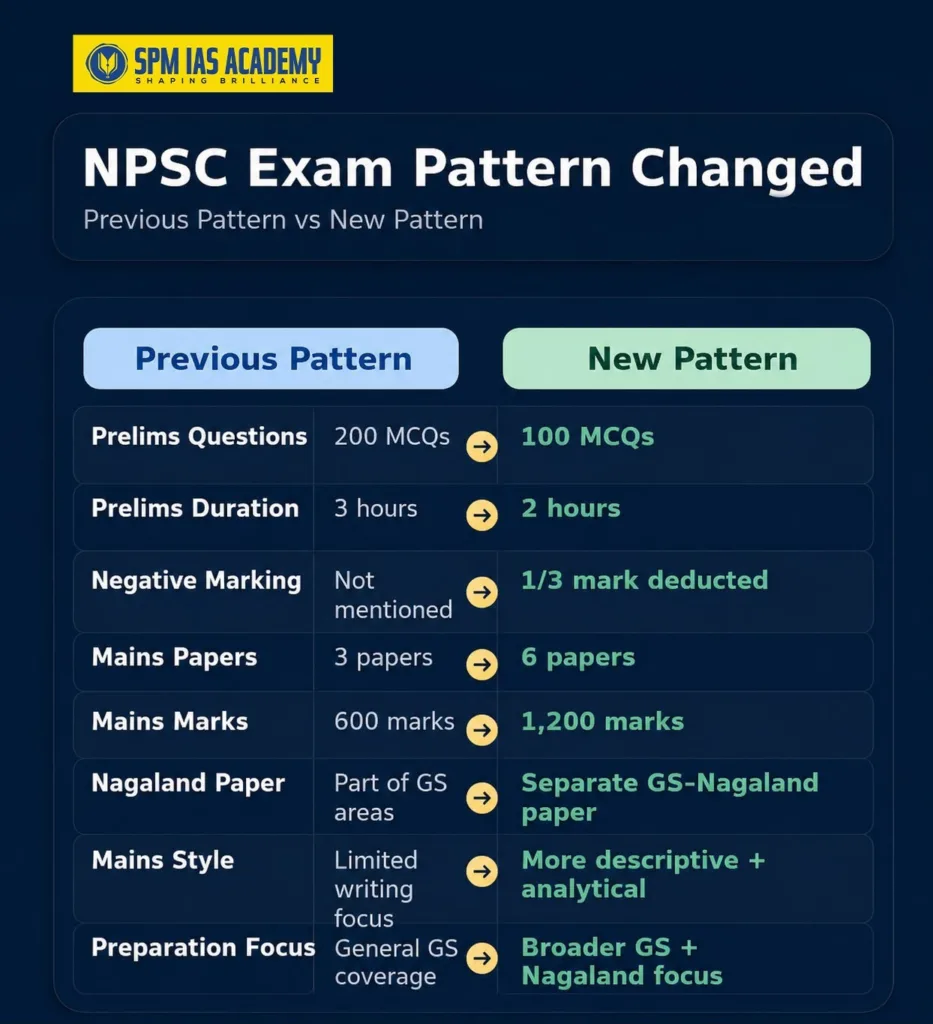
- Prelims Questions Have Been Reduced: Earlier, the Prelims had 200 MCQs. Now, the Prelims will have 100 MCQs. The total marks remain 200. So, each question now carries more weight.
- Prelims Duration Has Been Reduced: Earlier, the Prelims duration was 3 hours. Now, the duration is 2 hours. This makes time management more important.
- Negative Marking Has Been Introduced: There was no negative marking in the previous Prelims. Now, 0.66 marks will be deducted for each incorrect answer.
- Mains Has Been Expanded: Previously, the Mains Examination had 3 papers. Now, it has been restructured into 6 papers. Moreover, the total Mains marks have also increased from 600 to 1,200.
- A Separate GS–Nagaland Paper Has Been Added: Earlier, Nagaland-related topics were included within the broader General Studies papers. Now, a separate General Studies–Nagaland paper has been introduced.
- Mains Has Become More Descriptive and Analytical: Previously, the Mains pattern was shorter and less divided. Now, the amended pattern gives more focus to descriptive answers. Candidates will have to write structured answers within word limits. So, answer writing practice has become more important.
NPSC Old vs New Pattern: Key Differences
The NPSC Old vs New Pattern shows how the exam has shifted from a shorter structure to a more detailed and analytical format. The Prelims stage has become shorter and more accuracy-based. Moreover, the Mains has become wider and more analytical. Also, the new GS–Nagaland paper has made state-specific preparation more vital.
| Area of Comparison | Old Rules / Earlier Pattern | Amended Rules / New Pattern |
| Exam stages | Prelims, Mains and Interview | Prelims, Mains and Interview |
| Prelims paper | One General Studies paper | One objective-type General Studies paper |
| Number of Prelims questions | 200 MCQs | 100 MCQs |
| Total Prelims marks | 200 marks | 200 marks |
| Marks per question | 1 mark per question | 2 marks per question |
| Prelims duration | 3 hours | 2 hours |
| Negative marking in Prelims | No negative marking | One-third of the marks allotted to a question will be deducted for every wrong answer |
| Mains papers | 3 papers | 6 papers |
| Total Mains marks | 600 marks | 1,200 marks |
| Mains paper structure | General English, General Studies Paper I and General Studies Paper II | General Studies I, General Studies II, General Studies III, General Studies IV, General Studies–Nagaland and English Comprehension and Essay |
| Separate GS–Nagaland paper | Not available | Introduced as a separate paper |
| Nagaland-specific topics | Covered within broader General Studies | Given separate focus through the GS–Nagaland paper |
| Nature of Mains | Shorter and less divided | Wider, descriptive and more analytical |
| Preparation demand | Basic General Studies and English preparation | Prelims accuracy, Mains answer writing and separate Nagaland-specific preparation |
What are the Changes in NPSC Prelims Pattern?
The amended NPSC Prelims pattern is one of the biggest changes in the NPSC Old vs New Pattern. Earlier, Prelims was more about attempting more questions. Now, the focus has shifted towards accuracy, time management, and careful question selection.
Key Changes in NPSC Prelims Pattern
- Number of questions reduced: Earlier, the Prelims paper had 200 MCQs. Now, it has been reduced to 100 MCQs. This means every question now carries more value in the final Prelims score.
- Total marks remain the same: The Prelims paper still carries 200 marks. However, the number of questions has reduced. So, each question now carries 2 marks instead of 1 mark.
- Exam duration reduced: Earlier, candidates had 3 hours to complete the Prelims paper. Now, the duration has been reduced to 2 hours. This makes speed and time management more important.
- Negative marking introduced: One-third of the marks allotted to a question will be deducted for every wrong answer. Since each question carries 2 marks, 0.66 marks will be deducted for each incorrect answer.
What are the changes in the NPSC Mains Pattern?
Major changes have also been made in the Mains stage of the NPSC Exam. Earlier, the Mains stage was shorter and less divided. Now, it has become wider, more descriptive, and more analytical.
Explore the NPSC Mains 1200 Marks Strategy to prepare effectively for the revised descriptive examination pattern.
Key Changes in NPSC Mains Pattern
- Number of papers increased: The Mains Examination has now been expanded to 6 papers. In the old pattern, it had only 3 papers. This means aspirants have to cover more subjects in a structured way.
- Total marks increased: The total marks for Mains have increased from 600 to 1,200. As a result, the Mains stage now carries more weight and needs more serious preparation.
- General Studies section has become broader: The old pattern mainly had General Studies Paper I and General Studies Paper II. Under the amended pattern, the Mains includes General Studies I, General Studies II, General Studies III, and General Studies IV. So, the syllabus is now more divided and systematic.
- Separate GS–Nagaland paper added: Nagaland-related topics were earlier covered within broader General Studies. Now, a separate General Studies–Nagaland paper has been introduced. This makes state-specific preparation very important.
- English paper has been revised: General English has now been changed to English Comprehension and Essay. So, candidates should focus on comprehension, grammar, essay writing, and clear expression.
Conclusion
The amended rules have brought a major shift in the NPSC exam structure. The Prelims now require greater accuracy due to fewer questions and negative marking. At the same time, Mains has become wider with more papers and a separate GS–Nagaland paper. So, aspirants must understand both old and new rules clearly. With the right plan, regular revision, and answer writing practice, this new pattern can be handled confidently.
Frequently Asked Questions
The amended rules changed both Prelims and Mains. Prelims now has fewer questions, a shorter duration, and negative marking. Mains has been expanded from 3 papers to 6 papers. Also, a separate GS–Nagaland paper has been introduced to more clearly test state-specific knowledge in the exam.
Negative marking is important because it changes the Prelims strategy for the NPSC Exam. Earlier, candidates could attempt more questions without losing marks for wrong answers. Now, 0.66 marks will be deducted for each incorrect answer. So, aspirants need accuracy, revision, mock tests, and better question selection during the exam.

Behind every article at SPM IAS Academy is a team of skilled content writers and subject experts committed to making preparation easier for aspirants. From answering common doubts to breaking down complex issues and current affairs, we create content that is accurate, easy to understand, and directly useful for UPSC, APSC, and other competitive exams.