
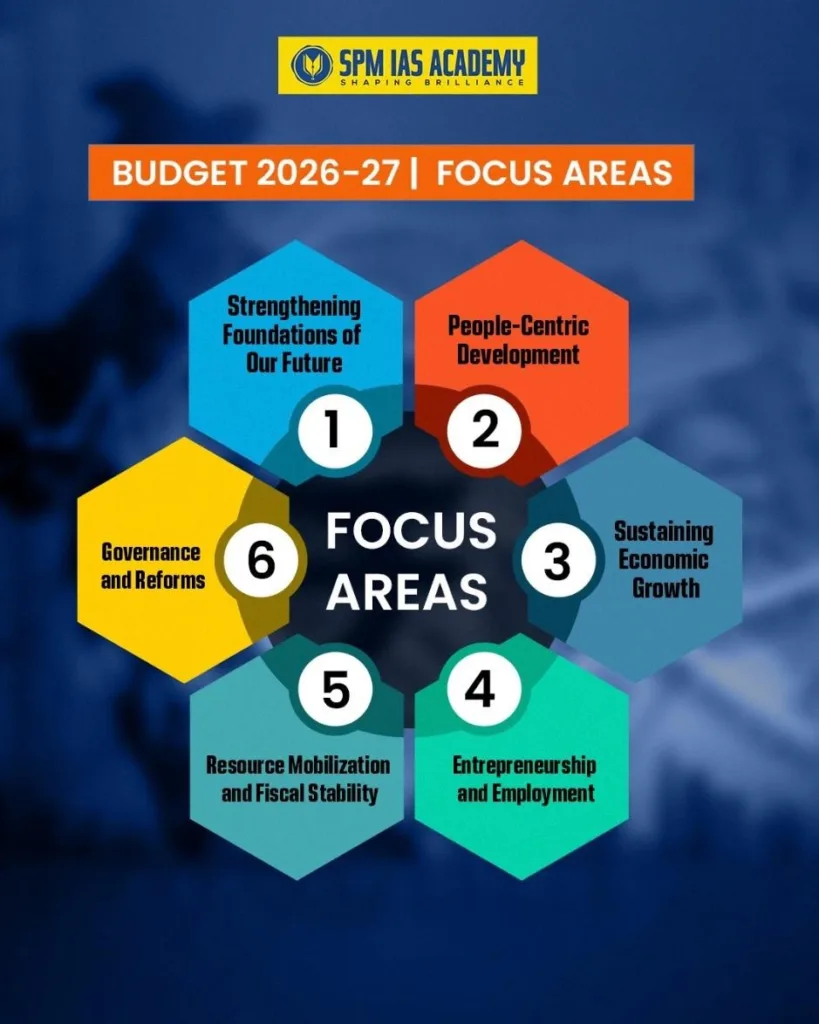
The Government of Arunachal Pradesh presented its Budget 2026-27 on 10th March 2026. The total projected receipts stand at ₹36,607 crore. The state’s GSDP is ₹41,314 crore at current prices. The budget focuses on six areas: Strengthening Foundations of Our Future, People-Centric Development, Sustaining Economic Growth, Entrepreneurship and Employment, Resource Mobilization and Fiscal Stability, and Governance and Reforms. Eight new schemes have been launched, including the ARUN MSME Mission, Donyi Polo Mission, and Arunachal Pradesh Startup Manch.
Arunachal Pradesh Budget 2026-27
The Arunachal Pradesh Budget 2026-27 is a highly significant current affairs topic for every APPSC aspirant. The government presented this budget on 10th March 2026, and it contains crucial information relevant to the APPSC Preliminary Examination, APPSC Mains (General Studies Papers I, II, and III), as well as the Interview stage. Therefore, candidates preparing for the Arunachal Pradesh Public Service Commission examination must study this budget thoroughly. Moreover, the budget covers multiple topics from the syllabus, including Indian Economy, Governance, Environment, Science and Technology, Social Justice, and Northeast India Development.
In this article, we present a comprehensive, exam-oriented analysis of the Arunachal Pradesh Budget 2026-27, highlighting key facts, figures, schemes, and important dimensions to help aspirants improve their performance in the APPSC examination.
Arunachal Pradesh Budget 2026-27 – Key Financial Facts at a Glance
Before we explore the focus areas, let us first understand the key financial numbers of this budget. These numbers are highly likely to appear as direct questions in APPSC Prelims 2026.
| Budget Presented on | 10th March 2026 |
| Gross State Domestic Product (GSDP) | ₹41,314 crore (at current prices) |
| Total Projected Receipts (BE 2026-27) | ₹36,607 crore |
| Revenue Receipts (BE 2026-27) | ₹30,733 crore |
| Capital Receipts (BE 2026-27) | ₹5,873 crore |
| Projected State Own Revenue (2026-27) | ₹5,208 crore (Tax ₹3,634 cr + Non-tax ₹1,575 cr) |
| Share of Central Taxes (BE 2026-27) | ₹20,665 crore |
| Share of Central Taxes (RE 2025-26) | ₹24,475 crore |
| Estimated Fiscal Deficit (2026-27) | ₹701 crore (1.70% of GSDP) |
| Fiscal Deficit (RE 2025-26) | ₹650 crore (1.57% of GSDP) |
| Fiscal Deficit (BE 2025-26) | ₹967 crore (2.02% of GSDP) |
Notably, the fiscal deficit for 2026-27 stands at 1.70% of GSDP, which is within the FRBM (Fiscal Responsibility and Budget Management) limit. This indicates fiscal prudence and good financial management by the state government.
Three Kartavyas – Arunachal Pradesh Budget Priorities for FY 2026-27
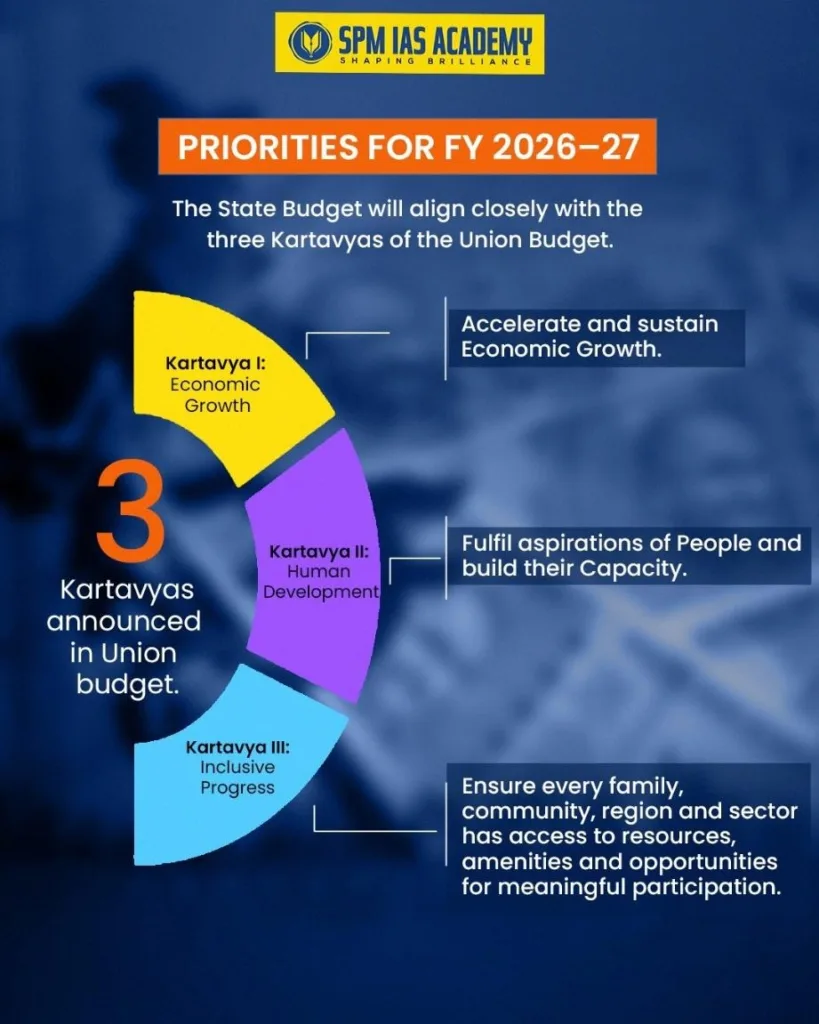
The Arunachal Pradesh Budget 2026-27 aligns closely with the three Kartavyas announced in the Union Budget of India. This alignment shows that the state government connects its planning with national-level development priorities.
Kartavya I: Economic Growth
The first priority focuses on accelerating and sustaining economic growth in the state. The government aims to attract investment, strengthen infrastructure and promote key sectors like hydropower, agriculture and tourism.
Kartavya II: Human Development
The second priority focuses on fulfilling the aspirations of the people and building their capacity. Consequently, the budget allocates significant funds for education, health, sports, and women empowerment.
Kartavya III: Inclusive Progress
The third priority ensures that every family, community, region, and sector has access to resources, amenities, and opportunities for meaningful participation. As a result, the budget reaches remote areas, border villages, and tribal communities.
The budget adopted a participatory approach, incorporating 1,834 citizen suggestions received through Jan Bhagidari and consultations with Community-Based Organizations (CBOs). Moreover, the government notified several key policies, including the Youth Policy, Olympic Sports Mission, Industrial & Investment Policy, Handloom & Handicrafts Policy (One Tribe, One Weave), as well as Agriculture, Horticulture, and Tourism Policies. Additionally, the Budget Monitoring Cell reported that over 91% of last year’s budget announcements are already in advanced stages of implementation. Therefore, the FY 2026-27 budget places strong emphasis on timely execution, improved coordination, and robust monitoring mechanisms.
Six Focus Areas of Arunachal Pradesh Budget 2026-27
Focus Area 1: Strengthening Foundations of Our Future
Under this focus area, the budget prioritises five major sectors — Connectivity, Hydropower, Power, Mining, and Environment & Climate Change.
Connectivity:
- Firstly, an Aero-city with world-class infrastructure will be developed near Donyi Polo Airport with an outlay of ₹90 crore.
- Additionally, a state-of-the-art convention centre integrated with a 100–150 room hotel will be constructed at Hollongi.
- Moreover, ₹500 crore has been allocated under the Chief Minister’s State Rural Roads Development Programme to build roads not covered under PMGSY.
- Furthermore, a feasibility fund will be created to support innovative transport solutions across the state.
Hydropower:
- Importantly, the government aims to commission 19 GW of hydropower capacity, attracting investments worth ₹1.9 lakh crore.
- In addition, construction of three new hydropower projects will begin in 2026–27.
- Moreover, the state plans to monetise power worth ₹4,520 crore between 2025 and 2035.
- Consequently, a Revised Small Hydro Power Policy has been notified to attract more private investors.
Power:
- Secondly, ₹500 crore has been allocated under the Chief Minister’s Comprehensive State Power Development Programme (CMCSPDP) to improve last-mile connectivity.
- Additionally, ₹70 crore has been earmarked for off-grid electrification of border and left-out villages.
- Furthermore, the government targets 100% feeder metering under CMCSPDP to enhance efficiency and reduce transmission losses.
Mining:
- Notably, the first commercial coal mine at the Namchick-Namphuk Central Coal Block is expected to become operational soon, strengthening the mining sector.
Environment, Forest & Climate Change:
- Importantly, four new protected areas have been notified — Nidak Danyi and Lipo Modi Wildlife Sanctuaries, along with Braiduah and Tukpen Community Reserves.
- Moreover, recruitment for the Special Tiger Protection Force will take place in 2026–27 for Pakke, Namdapha, and Kamlang Tiger Reserves.
- Additionally, Bird and Butterfly Festivals have been included as official calendar events to promote eco-tourism and awareness.
- Furthermore, a Five-Year Mission on Medicinal and Aromatic Plants has been launched.
- In parallel, biodiversity conservation at the village level will be strengthened using CAMPA funds.
- Finally, the government will use GIS mapping, camera traps, and drones to improve wildlife corridor protection and conservation efforts.
Focus Area 2: People-Centric Development
This focus area emphasises inclusive growth by prioritising Health, Education, Women & Child Welfare, Sports, Culture, Rural and Urban Development, Water Resources, Indigenous Affairs, and Research.
Health
- Firstly, new operation theatres, including advanced Cardio-Vascular OTs at TRIHMS, will be established.
- Additionally, a new district hospital at Tato and a hospital at Nafra will be constructed.
- Moreover, emergency and trauma centres will be set up in all districts in a phased manner.
- Furthermore, the Digital Health Initiative will be strengthened through electronic health records, thereby reducing out-of-pocket expenditure.
- In addition, enhanced support will be provided under the Renal Care, Cancer Therapy, and CM Organ Transplant Schemes.
- Importantly, the Arunachal Pradesh Substance Abuse Prevention Mission has been announced as a new initiative.
Education
- Secondly, the government will formulate a Comprehensive State Early Child Care and Education Policy.
- Additionally, a policy to teach a third language from Class I to VIII using local language textbooks will be introduced.
- Moreover, AVCG content creator labs will be set up in higher secondary schools and colleges in a phased manner.
- Furthermore, a Centre for Japanese Language Studies will be established at Arunachal Pradesh University.
- In addition, infrastructure upgrades will be undertaken at Govt. Model Degree College Kanubari, Govt. Engineering College Tezu, Govt. College Doimukh, and Arunachal Pradesh University.
- Significantly, girls’ hostels will be constructed in every district to promote access to higher education.
Women and Child Development
- Importantly, SHE Marts will be established to enable women to own and operate enterprises.
- Moreover, food fortification will be introduced under the Supplementary Nutrition Scheme.
- Additionally, the Dulari Kanya Yojana will be strengthened with direct cash incentives.
- Furthermore, hostels for working women will be constructed in all 26 districts with an outlay of ₹188 crore.
Sports and Youth Development
- Firstly, the CM Athletics Coaching and Empowerment Scheme and Mission Olympics have been launched.
- Additionally, ₹10 crore has been allocated under the CM School Sports Programme.
- Moreover, the Arunachal State Games will be proposed as a regular calendar event.
- Furthermore, the Khelo India Mission will be implemented across the state.
- In addition, the Financial Literacy Programme will be expanded to colleges, training institutes, and startup hubs.
Art and Culture
- Importantly, the government proposes the construction of the Walong War Memorial and Museum to honour martyrs.
- Moreover, monuments and archaeological sites will be identified, restored, and preserved in a phased manner with Government of India support.
Rural Development and Panchayati Raj
- Firstly, 10% of the State’s Own Tax revenue, amounting to ₹280 crore, will be devolved to Panchayati Raj Institutions (PRIs).
- Additionally, Panchayat Bhawans will be established in all uncovered districts.
Urban Development
- Moreover, four new municipalities have been notified at Aalo, Ziro, Tawang, and Namsai.
- Furthermore, a ₹200 crore ring-fenced fund has been created for scientific waste management and urban sanitation.
- In addition, a waste-to-charcoal plant will be established at Itanagar.
- Additionally, wastewater treatment plants will be developed in all 27 census towns.
Water Resources
- Importantly, a high-powered committee will be constituted to suggest measures for the judicious and sustainable long-term management of water resources.
Public Health Engineering & Water Supply (PHE & WS)
- Moreover, new water supply projects will be implemented in Lower Dibang, Longding, West Kameng, Lower Subansiri, Upper Subansiri, Anjaw, and East Kameng in a phased manner.
- Additionally, Mission Clean Toilet will be launched to further strengthen sanitation and public health.
Transport
- Firstly, a new policy will be proposed to enhance Electric Vehicle (EV) adoption.
- Additionally, 50 new electric buses will be introduced to reduce carbon emissions.
Indigenous Affairs
- Importantly, the first Yerko Gurukul for girls will be established.
- Moreover, GI-tagged products will receive marketing and branding support to achieve the target of 50 GI-tagged products by 2030.
- Additionally, ₹5 crore has been allocated for the Puroik Welfare Board.
Research and Innovation
- Under the Gyan Bharatam Mission, age-old Buddhist indigenous and medicinal manuscripts will be documented, digitised, and scientifically preserved.
- Furthermore, the DONYI POLO Mission (Digitizing Oral, Native, Yore & Indigenous – Preserving Our Linguistic Origins) will be launched.
- Additionally, the BHASHINI Rajyam Programme will be implemented to develop AI-powered speech recognition and translation models.
Overall, this focus area reflects a comprehensive approach toward inclusive, sustainable, and people-centric development across Arunachal Pradesh.
Focus Area 3: Sustaining Economic Growth:
This focus area aims to strengthen long-term economic growth by prioritising Agriculture, Tourism, Textiles, and Ease of Doing Business.
Agriculture and Allied Sectors:
- Firstly, the state has set a target of cultivating over 36,000 hectares of oil palm by 2027 under the National Mission on Edible Oils.
- Moreover, under various Atmanirbhar schemes, 59,491 farmers and 2,000 Self-Help Groups (SHGs) have already received support.
- Additionally, an Agriculture College in East Kameng, with an outlay of ₹74 crore, is scheduled for completion in FY 2026–27.
- Furthermore, the Arunachal Millet and Buckwheat Mission has been expanded to promote nutritional security and crop diversification.
- In addition, the AI-based Bharat-VISTAAR advisory platform has been implemented to provide farmers with technology-driven guidance.
- Significantly, an Orchid and Floriculture Pilot Project will be introduced in select districts to boost horticulture-based income.
- Similarly, the Kiwi Mission and Mushroom Development Mission have been expanded to enhance high-value crop production.
- Importantly, a Yak Fibre Processing Common Facility Centre will be established at Dirang to promote livestock-based livelihoods.
- Moreover, the CM White Revolution Scheme 2.0 has been launched to strengthen dairy development.
- Additionally, the development of Amrit Sarovars will support fisheries and improve rural livelihood opportunities.
Tourism:
- Firstly, the government will establish a World War II Heritage Museum and restore the WWII Cemetery linked to the legacy of the Stilwell Road.
- Moreover, a Policy on Safe Adventure Tourism has been implemented to promote responsible and secure tourism.
- Additionally, the Siang Adventure and Eco Retreat in Pasighat, with an outlay of ₹46.48 crore, will be completed in FY 2026–27.
- Furthermore, wine tourism will be promoted to diversify tourism offerings and boost the local economy.
Textile and Handicrafts:
- Importantly, five new sericulture initiatives will be launched with an outlay of ₹25 crore to empower women economically.
- Additionally, national textile and handicraft programmes will be implemented to support traditional artisans and expand market access.
Ease of Living and Ease of Doing Business:
- Firstly, the government will simplify rules and digitise public services in a time-bound manner to enhance both Ease of Living and Ease of Doing Business.
- Moreover, digitalisation efforts will integrate all Deputy Commissioner (DC) offices and 40 Additional Deputy Commissioners (ADCs) with 22 online services across 10 departments.
- Consequently, these reforms aim to improve administrative efficiency, transparency, and investor confidence while promoting sustainable economic growth.
Focus Area 4: Entrepreneurship and Employment
This focus area aims to generate sustainable employment by promoting MSMEs, industries, skill development, and start-up ecosystems.
Entrepreneurship Initiatives:
- Firstly, the ARUN MSME Mission will provide annual financial and institutional support to enterprises while leveraging the One District, One Product strategy.
- Moreover, the Corporate Mitra Programme has been implemented to strengthen industry linkages and provide mentorship to emerging businesses.
Industries:
- Importantly, the government proposes a dedicated Policy for Large and Medium Enterprises to attract investment and complement the UNNATI Scheme.
- Additionally, an Industrial Park at Balinong will be established to promote manufacturing and industrial growth.
Skill Development:
- Furthermore, one ITI will be upgraded into a Centre of Excellence equipped with Industry 4.0 facilities and advanced courses, thereby preparing youth for future-ready jobs.
- In addition, the government plans to train 250 Allied Health Professionals and 500 caregivers in core care and allied skills to meet growing healthcare demands.
Start-ups and Innovation Ecosystem:
- Significantly, ₹200 crore has been allocated in FY 2026–27 under the Deen Dayal Upadhyaya Swavalamban Yojana to support over 2,500 beneficiaries.
- Moreover, the proposed Arunachal Pradesh Startup Manch will provide mentorship, funding, and networking support to entrepreneurs.
- Additionally, under Entrepreneurship Development Programme 4.0, the intake of start-ups and the provision of seed funding will be doubled to accelerate innovation-led growth.
Overall, this focus area reflects a strong commitment to boosting employment, empowering entrepreneurs, and building a future-ready workforce.
Focus Area 5: Resource Mobilization and Fiscal Stability
This focus area emphasises strengthening financial management and improving revenue generation for long-term fiscal stability.
Centrally Sponsored Schemes (CSS)
- Firstly, a high-level committee will be constituted under the Chief Secretary to conduct monthly reviews of the implementation of Centrally Sponsored Schemes (CSS).
- Therefore, this step aims to improve coordination, monitoring, and timely utilisation of central funds.
Enhancement of State’s Own Resources
- Moreover, the Department of Tax, Excise and Narcotics will be bifurcated into two separate entities — the Excise & Narcotics Department and the Commercial Tax Department — to improve efficiency and accountability.
- Additionally, the power sector will be restructured to ensure reliable electricity supply and stronger financial discipline.
- Furthermore, a dedicated Power Revenue Cell will be created to enhance revenue collection and reduce losses.
- Significantly, a task force will be formed to explore opportunities in carbon credits and green bonds, thereby promoting sustainable financing and climate-responsive resource mobilisation.
Focus Area 6: Governance and Reforms
This focus area aims to strengthen administrative efficiency, transparency, and institutional capacity across departments.
Administrative Reforms:
- Firstly, the government will implement e-HRMS (Electronic Human Resource Management System) in all departments to streamline personnel management.
- Moreover, the Common Directorate Complex will be operationalised to improve coordination among departments.
- Additionally, Phase III redevelopment of government quarters in the Capital Complex will be undertaken.
- Furthermore, Phase II of District Headquarters accommodation expansion and infrastructure development will also be carried out.
- Importantly, comprehensive land record management systems will be developed in Leparada, Tirap, Pakke Kesang, Siang, and Kamle, thereby improving transparency and land governance.
Police Reforms:
- Significantly, ₹25 crore has been allocated in FY 2026–27 as part of a special package for strengthening the police force.
- In addition, extra funds will be allocated for equipment procurement for forensic science laboratories, enhancing investigative capacity.
Fire and Emergency Services:
- Moreover, new fire stations will be established at 11 locations.
- Additionally, four existing fire stations will be upgraded to improve emergency response infrastructure.
e-Inner Line Permit (e-ILP) System:
- Furthermore, the e-ILP ecosystem will be strengthened through integrated databases and improved tracking mechanisms.
- In addition, stricter monitoring of overstays and enhanced digital infrastructure at check gates will be implemented.
Science and Technology:
- Finally, the DBT-APSC Centre of Excellence for Bioresources and Sustainable Development at Kimin will be upgraded to promote research and innovation.
Newly Announced Schemes in Arunachal Pradesh Budget 2026-27
The budget announces eight new schemes. APPSC aspirants must memorise all of them as these are likely to appear in Prelims MCQs and as examples in Mains answers.
| Five-Year Mission on Medicinal and Aromatic Plants | Brings native medicinal knowledge and plant wealth into global value chains |
| Arunachal Pradesh Substance Abuse Prevention Mission | Addresses drug and substance abuse problems in the state |
| Financial Literacy Programme | Expanded to colleges, training institutes, and startup hubs |
| DONYI POLO Mission (Digitizing Oral Native, Yore and Indigenous- preserving our linguistic origin) | Digitizing Oral, Native, Yore & Indigenous — Preserving Our Linguistic Origins |
| Seri Yuva Mitra | Youth-focused sericulture support programme |
| Young Silk Weaver Skill Development Initiative | Skill development for youth in silk weaving |
| ARUN MSME Mission | Annual support to MSMEs; uses One District, One Product model |
| Arunachal Pradesh Startup Manch | Mentorship and funding support for startups |
Conclusion: Arunachal Pradesh Budget 2026-27
The Arunachal Pradesh Budget 2026-27 is a comprehensive document that touches every aspect of the state’s development — from hydropower and agriculture to digital governance and cultural preservation. For every APPSC aspirant, this budget offers rich material for Prelims MCQs, Mains essay-type answers, and even the interview stage.
To summarize, the six focus areas — Strengthening Foundations of Our Future, People-Centric Development, Sustaining Economic Growth, Entrepreneurship and Employment, Resource Mobilization and Fiscal Stability, and Governance and Reforms — together reflect a balanced, people-first, growth-oriented budget. Moreover, the eight newly launched schemes, including the DONYI POLO Mission, ARUN MSME Mission, and Arunachal Pradesh Startup Manch, open new dimensions for the state’s economic and cultural future.
At our coaching centre, we provide exam-focused analysis of state budgets, current affairs for APPSC, and comprehensive study material tailored specifically for the Arunachal Pradesh Public Service Commission examination. Our expert faculty connects every budget provision to the APPSC syllabus so that you can write high-scoring Mains answers with confidence.
Source:
https://www.arunachalbudget.in/docs/glance.pdf
The total projected receipts of the Arunachal Pradesh Budget 2026-27 are ₹36,607 crore.
Arunachal Pradesh’s GSDP is estimated at ₹41,314 crore at current prices in 2026.
The budget focuses on six key areas, including infrastructure development, people-centric welfare, economic growth, entrepreneurship, fiscal stability, and governance reforms. Therefore, it reflects a balanced development strategy.
The government launched eight new schemes, including the ARUN MSME Mission, DONYI POLO Mission, and Arunachal Pradesh Startup Manch. Additionally, these schemes promote entrepreneurship, cultural preservation, and social development.
The fiscal deficit for 2026-27 is at ₹701 crore, which is 1.70% of GSDP. Importantly, this remains within the FRBM limit, indicating fiscal discipline.

Behind every article at SPM IAS Academy is a team of skilled content writers and subject experts committed to making preparation easier for aspirants. From answering common doubts to breaking down complex issues and current affairs, we create content that is accurate, easy to understand, and directly useful for UPSC, APSC, and other competitive exams.