
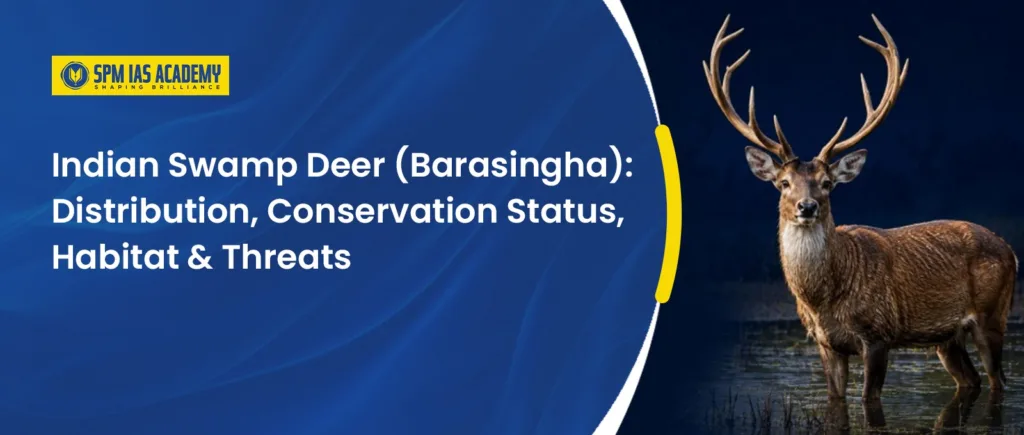
The Indian Swamp Deer (Barasingha) is one of the most distinctive deer species of the Indian subcontinent. Scientifically known as Rucervus duvaucelii, it survives mainly in fragmented grassland and wetland habitats in India and Nepal. This topic is also relevant for aspirants preparing for competitive examinations, and APSC coaching in Assam can provide structured guidance for covering Assam-specific geography, environment, and general studies.
The species has attracted fresh conservation attention because successful translocation programmes are creating additional populations. In Madhya Pradesh, hard-ground Barasingha translocated from Kanha to Satpura increased from 98 founder animals to 172 by 2023. Meanwhile, Assam’s Eastern swamp deer population in Manas National Park has shown a strong recovery after animals were moved from Kaziranga.
For UPSC, APSC and State PCS examinations, Barasingha is important under biodiversity, protected areas, grassland ecosystems, species conservation and wildlife translocation.
What is the Indian Swamp Deer (Barasingha)?
- The Indian Swamp Deer (Barasingha) belongs to the Cervidae family. The word “Barasingha” roughly refers to the characteristic multi-tined antlers of adult males, which commonly develop around twelve or more points.
- Barasingha mainly depends on grasslands, floodplains, marshes and wetland vegetation. However, one subspecies, the hard-ground Barasingha has adapted to drier grasslands bordering Sal forests.
- The Wildlife Institute of India identifies three major subspecies: R. d. duvaucelii, R. d. branderi and R. d. ranjitsinhi/ranjitsinhii. Such biodiversity and wildlife topics are important for competitive exam preparation, and APSC online classes can help aspirants study environment and ecology topics in a structured manner
Indian Swamp Deer (Barasingha) Distribution in India
Historically, swamp deer occurred across the Indus-Gangetic plains, Brahmaputra floodplains and Central Indian grasslands. However, due to loss of habitation and increasing hunting drastically reduced their distribution. The species is now extinct from Pakistan and Bangladesh and survives mainly in India and Nepal.
The three subspecies have different geographical ranges:
| Subspecies | Main Habitat | Important Distribution |
| Northern/Wetland Barasingha – R. d. duvaucelii | Flooded grasslands and wetlands | Dudhwa landscape, Kishanpur, Katerniaghat and other pockets of Uttar Pradesh; Jhilmil Jheel in Uttarakhand; Nepal |
| Hard-ground Barasingha – R. d. branderi | Dry grasslands near Sal forests | Kanha, Satpura and newly established populations including Bandhavgarh in Madhya Pradesh |
| Eastern Barasingha – R. d. ranjitsinhi | Tall alluvial grasslands and wetlands | Kaziranga and Manas National Parks in Assam |
Indian Swamp Deer (Barasingha) Conservation Status
The Barasingha conservation status is one of the important topics for Prelims. Its conservation status is as given below. Aspirants preparing for competitive examinations can also benefit from civil service coaching in Guwahati for structured coverage of environment, ecology, and other Prelims subjects.
- IUCN Red List: Vulnerable
- CITES: Appendix I
- Wild Life (Protection) Act, 1972: Schedule I protection
- Hard-ground Barasingha: State animal of Madhya Pradesh
Therefore, protecting the species also supports the conservation of India’s increasingly threatened wetlands and grassland ecosystems.
What are the Major Threats to Indian Swamp Deer (Barasingha)
The decline of the Indian Swamp Deer (Barasingha) primarily reflects the loss and fragmentation of its specialised habitat. Understanding such environmental and conservation issues is important for competitive exam aspirants, and Assam Civil Service Academy can support structured preparation for relevant subjects.
Major Barasingha threats include:
- Grassland conversion: Agriculture and infrastructure have replaced large areas of natural grassland.
- Wetland degradation: Drainage, altered river flows and siltation reduce suitable feeding and breeding habitats.
- Habitat fragmentation: Small, isolated populations face greater demographic and genetic risks.
- Poaching and hunting: Historical hunting severely reduced several populations.
- Invasive plants: Species such as Lantana can degrade native grasslands.
- Floods and fires: Severe floods or poorly timed grassland fires can increase mortality, especially among fawns.
- Disease and small-population risk: Concentrating a subspecies in one location creates vulnerability to disease outbreaks or environmental disasters.
Barasingha Conservation: Kanha, Satpura and Bandhavgarh Success
The recovery of the hard-ground Barasingha is one of India’s notable wildlife conservation stories.
- At Kanha Tiger Reserve, the population had fallen to only about 66 animals in 1967. Habitat improvement, grassland management, protection and controlled breeding helped revive it. Recent reporting places the Kanha population at around 1,100 animals.
- However, conservationists recognised the risk of keeping an entire subspecies in one location. Therefore, authorities began moving animals from Kanha to Satpura Tiger Reserve.
- Between 2015 and 2023, 98 hard-ground swamp deer were translocated to Satpura. By 2023, the population had risen to 172, with second and third generation animals indicating successful breeding. Authorities have also established a new population in Bandhavgarh Tiger Reserve.
This programme demonstrates the importance of conservation translocation, habitat restoration and creating geographically separate populations.
Eastern Swamp Deer Conservation in Assam
Assam provides another major conservation example.
- Civil unrest, hunting and habitat related pressures had drastically reduced the swamp deer population in Manas National Park. Therefore, the Assam Forest Department and conservation partners moved 36 Eastern swamp deer from Kaziranga to Manas in 2014 and 2017.
- The estimated Manas population subsequently increased from 62 animals in 2017 to 174 in 2023, with an average annual exponential growth rate of about 17% during the study period. Researchers identified the translocation as a major driver of this recovery.
Conclusion
The Indian Swamp Deer (Barasingha) shows how habitat protection, scientific translocation and long-term monitoring can reverse wildlife decline. However, fragmented grasslands, wetland degradation, fires and small isolated populations continue to pose threats.
Therefore, conserving Barasingha requires India to protect not only an individual species but also the grassland and wetland ecosystems on which many threatened animals depend.
Read More:
Source:
Frequently Asked Questions
1. Where is the Indian Swamp Deer (Barasingha) found in India?
The Indian Swamp Deer (Barasingha) survives mainly in fragmented grassland and wetland habitats across northern, central and northeastern India. Major populations occur in Dudhwa, Kanha, Satpura, Bandhavgarh, Kaziranga and Manas. Moreover, the Eastern Barasingha is especially associated with the alluvial grasslands of Assam.
2. What is the conservation status of the Indian Swamp Deer (Barasingha)?
The Indian Swamp Deer (Barasingha) is listed as Vulnerable on the IUCN Red List and included in CITES Appendix I. In addition, it receives Schedule I protection under the Wild Life (Protection) Act, 1972. Therefore, the species receives strong legal and international conservation protection.
3. What are the major threats to the Indian Swamp Deer (Barasingha)?
The main threats to the Indian Swamp Deer (Barasingha) include grassland conversion, wetland degradation, habitat fragmentation, poaching, invasive plants, floods, fires and small isolated populations. However, conservation measures such as habitat restoration and scientific translocation have helped recover populations in places like Kanha, Satpura and Manas.

Behind every article at SPM IAS Academy is a team of skilled content writers and subject experts committed to making preparation easier for aspirants. From answering common doubts to breaking down complex issues and current affairs, we create content that is accurate, easy to understand, and directly useful for UPSC, APSC, and other competitive exams.